
Gold bars and gold coins both satisfy the 99.5 % purity rule demanded of investment-grade metal, yet they serve different portfolio purposes. Bars hold the edge for long-term bulk commitment, while coins add daily liquidity and, in the UK, CGT-free status when they carry Britannia or Sovereign legal-tender status. Both forms oblige the buyer to arrange secure storage and full insurance cover, and coins can retreat to a discount if collector premiums cool.
Expert behind this article

Thomas Goldfreburg
Thomas Goldfreburg is a gold investment advisor, author and founder of Goldfreed. Thomas's expertise is built on an academic foundation of a Bachelor of Science in Economics from Stanford University and complemented by market experience. Thomas specializes in gold IRA, ETF, 401k, and physical gold investments.
What are the pros and cons of gold coin investment?
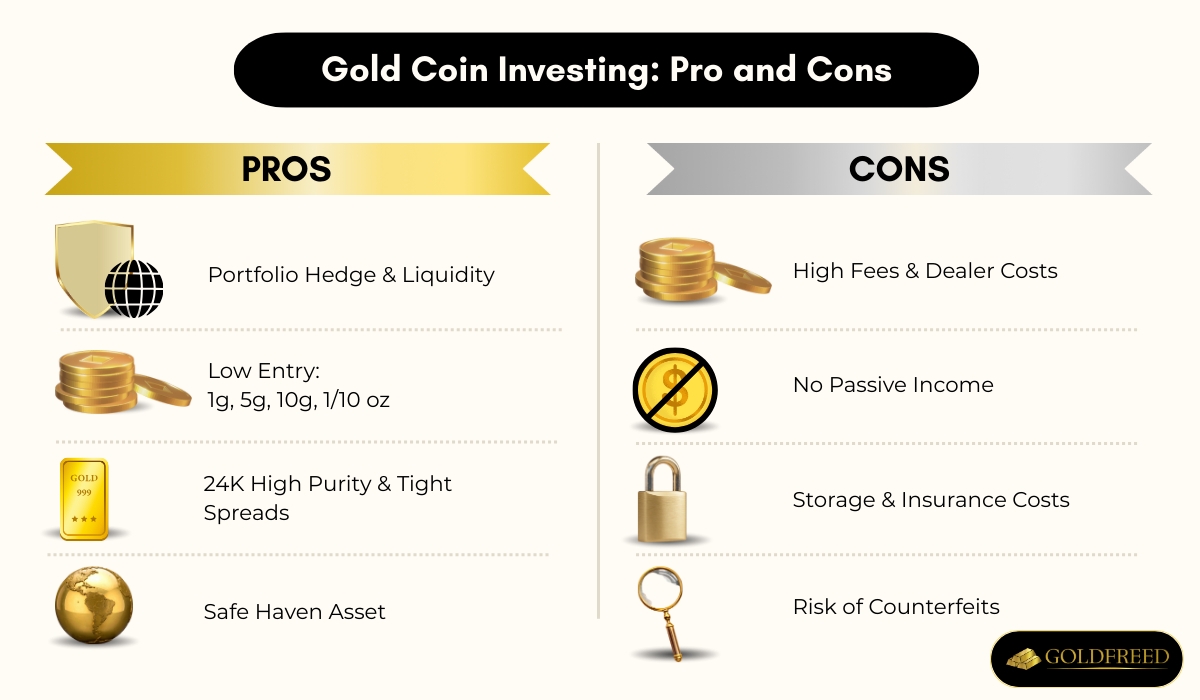
The pros are that gold coin investment adds balance and security to a portfolio through hedging and liquidity, and coins are bought in small denominations like 1 g (0.035 oz), 5 g (0.176 oz), 10 g (0.353 oz) or 1/10 oz (3.11 g), making the entry level low and suitable for beginners. 22 K coins offer durability and numismatic value, while 24 K coins offer the highest purity and tightest spreads. Both forms provide capital-gains-tax advantages in some jurisdictions, for example, UK Britannia and Sovereign coins are exempt from CGT when held in a Stocks and Shares ISA. High liquidity is a pro as coins are easy to carry, ship, and sell worldwide, and they act as a safe haven during inflation, currency instability, or geopolitical unrest.
The main cons are cost and complexity. Gold coins have a round-trip dealing spread of 7-10 percent when bought through traditional coin dealers, so investors lose 7 to 10 % at purchase, and the same coins receive a poor resale price without proper authentication. Storage and insurance fees add to the overall cost, and investors need to pay extra for secure storage facilities or insurance if they keep coins at home. There is a risk of counterfeit or forgery, and coins require validation before resale. Gold does not generate passive income or dividends, and physical gold is subject to capital gains tax when sold, so the investment has added costs and tax exposure that must be budgeted in advance.
I recognize the portability of metal money and the divisibility of coins, so I can cash in a part of my properties without selling a whole bar. Yet I must admit the substantial disadvantage of charges: the agio constitutes the price of minting, design, decoration, allocation and marketing. Precious metal medallions typically bring a steeper price over the spot cost of gold compared to bars, and upper price erodes my possible earnings edges. The collectible worth of definite coins introduces a factor of industry danger distinct from the inherent worth of the precious metal itself.
Thomas GoldfreburgInvestor at Goldfreed
Are gold bars a good investment?
Gold bars are a good investment because gold tends to be appreciated amid inflation or currency crises and amid economic tensions and turmoil. Gold provides you with a sense of financial security.
Gold bars are a solid long-term investment and are often purchased as a hedge against challenging macroeconomic conditions. They are deemed a safe-haven investment during political and financial uncertainty, they diversify a portfolio, and they are regarded as one of the most cost-effective ways to invest in gold. Gold bars are investment-grade bullions that must have a specific weight, shape, and purity between 0.995 % and 0.9999 %. 1-kilo and 500-gram sizes are a good investment option for high-net-worth investors, whereas 1-gram bars carry massive premiums and do not represent a good investment for most people. Gold bars are a financial insurance position rather than an income-producing asset as they do not generate yield, they are subject to market price fluctuations, and they swing dramatically in the short term, yet over decades they have repeatedly acted as a stabilizer during turbulent times and preserved capital. Investors can buy gold bars online from LBMA-approved refiners and sovereign mints. At Costco in Canada 1-ounce 24-carat bars sell for $2,679.99 with a limit of two bars every seven days, and worldwide any bullion dealer will exchange bars as long as the refiner appears on the LBMA good-delivery list. Before purchasing, investors use a gold-return calculator to weigh storage and insurance costs against expected inflation hedging, and they consult an investment guide to confirm that the size and grade they choose fit within their overall allocation and IRA-eligibility rules.
Gold bars constitute a good long-term venture for important portfolio diversification. I discovered precious metal bars to be a straightforward and effective medium for money conservation so I switched to gold bars. Buying bigger bars lets a larger part of my asset to be allotted to the true element, and I found the main benefit is reduced charge over the spot cost of precious metal compared to coins. A sole one-ounce bar is simpler to keep and handle, yet it includes the identical rich as dual less coins. Their heavy liquidity and interchangeable characteristics give huge self-assurance, and I recognize the physical protection of having a compact stock of worth. This efficiency is overriding for a capitalist whose main goal is the pure accrual of weight in wealth.
Thomas GoldfreburgInvestor at Goldfreed
Which is better investment: gold coin or gold bar?
The comparison between gold coin and gold bar as better investment options is given in the table below.
| Attribute | Gold Bars | Gold Coins |
|---|---|---|
| Premiums | 1-4% | 5-7% |
| Flexibility | Gold bars cannot sell portions | Gold coins allow selling in small amounts |
| Storage Costs | Gold bars have lower storage costs | Coins can be stored discreetly (e.g., fireproof safe) |
| Production Costs | Gold bars are cheaper to produce | Gold coins have higher production costs |
| Purity | 99.5% purity | 90% purity |
| Size/Weight Options | 1 oz (28.35 g) to 1 kilo (32.15 oz) | Typically smaller (e.g., 1 oz (28.35 g) Krugerrand) |
| VAT Exemption | Gold bars are VAT-exempt in the UK | Gold coins are VAT-exempt in the UK |
| Capital Gains Tax | Subject to Capital Gains Tax | Subject to Capital Gains Tax |
| Portfolio Diversification | Diversify portfolio | Diversify portfolio |
| Bulkiness | More bulky | Less Bulky |
| Selling Portions | Must sell entire unit | Easier to split into smaller portions |
Gold bars have lower premiums (1-4 %) compared to gold coins (5-7 %), so each gram costs less when bought ounce-for-ounce. They have higher purity, are cheaper to produce, and incur lower storage cost, yet they are bulkier than coins and you cannot sell a portion of a bar. Coins are better if you desire flexibility to sell in small amounts, because they allow you to split investment into smaller manageable portions and are easier to store discreetly, like in a fire-proof safe at home. Gold bullion coins offer more flexibility than large gold bars, while bars often require purchasing a pricey safety-deposit box or bank vault.
Gold bullion is internationally classified as bars of at least 99.5 % purity or coins of at least 90 % purity, and both forms are exempt from VAT in the UK since 1 January 2000. Key factors to note include premiums, flexibility, and impact of Capital Gains Tax for large sums. Compared with jewellery, bullion bars and coins carry lower mark-ups and are instantly tradable by weight and fineness, whereas jewellery premiums cover craftsmanship and fashion, and resale value is discounted. For pure investment, either bars or coins outperform jewellery.
A balanced conclusion is that diversifying your portfolio with both bars and coins is recommended: use bars for the cheapest exposure per ounce and coins for adjustable liquidity.