Gold is highly popular among precious metals as an investment because it is a high-quality store of value and a diversifier that can mitigate losses in times of market stress. Investors generally buy gold as a way of diversifying risk, since factors like jewellery demand, central bank purchases, and mining output help shape the investment case for gold.
Physical bullion, 100 percent pure in investment form, satisfies preferences for physical ownership, while Gold ETFs, gold exchange-traded products, and gold mutual funds suit investors who prefer market-traded vehicles. Gold investment can be achieved through buying gold mining shares or gold mutual funds, and holders may enroll in a gold saving scheme to accumulate the metal systematically. Whatever gold investment type aligns with your risk tolerance and knowledge level, the framework of definition, types, role, steps, and scheme set out below guides effective participation.
Expert behind this article

Thomas Goldfreburg
Thomas Goldfreburg is a gold investment advisor, author and founder of Goldfreed. Thomas's expertise is built on an academic foundation of a Bachelor of Science in Economics from Stanford University and complemented by market experience. Thomas specializes in gold IRA, ETF, 401k, and physical gold investments.
What is the definition of gold investment?
Gold investment refers to buying gold in its physical form or through securities like stocks, futures, and exchange-traded funds (ETFs) backed by gold.
Gold investment is the commitment of capital to gold with the expectation of preserving or increasing value over time. It covers two broad approaches: acquiring the physical asset and gaining exposure through securities. In its tangible form, investment is made by buying gold bullion, platelets, bars or coins whose fine gold content is at least 995 thousandths for bullion products and 900 thousandths for coins. These products are globally recognised and trade close to the intra-day spot price. Investors buy gold through securities like exchange-traded funds, mining shares, futures, options, or mutual funds. These instruments offer liquidity and diversification without storage concerns.
Regardless of the channel chosen, the underlying motive is uniform: gold investment aims to profit from selling the metal at a higher price than that paid, to achieve capital appreciation in line with the gold price, and to preserve purchasing power. Because gold is scarce, highly liquid and maintains its value over time, it is widely viewed as a safe-haven asset that hedges against inflation, market volatility and inevitable economic contractions.
Gold investment is the intentional act of allotting a part of my financial funds into precious metal or gold-related investments. It incorporates buying tangible bars or coins, and it possesses the main aim of conserving and increasing my money over the lengthy period. I see it as a strategy choice that maintains my portfolio with a physical resource that has kept its inherent worth for millennia.
Thomas GoldfreburgInvestor at Goldfreed
What are the types of gold investment?
The types of gold investment are outlined below.
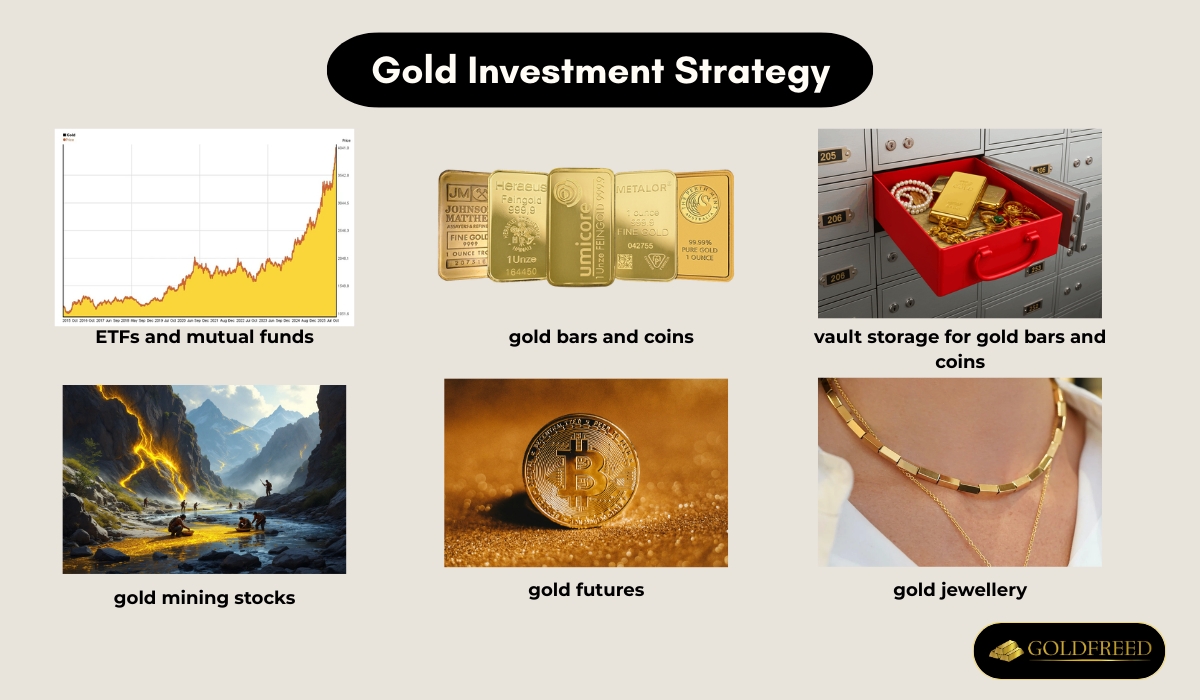
- Gold investment includes gold funds like ETFs and mutual funds
- Gold investment includes gold bars and coins
- Gold investment includes physically-backed gold exchange-traded funds
- Gold investment includes vault storage for gold bars and coins
- Gold investment includes gold mining stocks
- Gold investment includes gold futures
- Gold investment includes gold stocks
- Gold investment includes physical bullion
- Gold investment includes sovereign gold bonds
- Gold investment includes digital gold
- Gold investment includes gold jewellery
Investors have several options when looking to gain exposure to gold. The four main options are physical bullion, ETFs, sovereign gold bonds, and digital gold. Physical gold is purchased as gold jewellery, although the types of gold coating or use vary from cheaper gold-plating to solid gold. Gold ETFs give investors the flexibility to buy and sell shares like a stock. Gold mining stocks are another way that investors gain exposure to gold, though these stocks don't always track gold's long-term performance very closely. Gold mining stocks do not require physical gold ownership. Gold futures are probably the most efficient way to invest in gold, giving investors the flexibility to go long or short on gold. Gold futures are traded on regulated exchanges and have an expiration date. They include quality, quantity, price, and date specifications, and allow investors to take physical delivery of the metal.
I apportioned a part of my reserves to Sovereign Gold Bonds, securities that follow the cost of precious metal and give a steady percentage rate, so these bonds give a twofold advantage. I inserted various precious metal bars to my assortment, then set up a protected finance cabinet to safeguard against stealing or failure. I included old jewelry to my assortment, holding that tiny big fragment of antiquity in my arm while paying yearly policy payments to insure it.
Thomas GoldfreburgInvestor at Goldfreed
What is digital gold investment?
Digital gold investment refers to the modern way of investing in gold without physically owning it, and Digital Gold allows investors to buy, sell, hold and trade gold electronically. Digital Gold represents ownership through digital platforms, so individuals can buy and sell gold securely in digital form. Digital gold is a secure and reliable investment option.
Digital gold is an asset based on blockchain that is linked to the price of physical gold. It represents ownership through digital platforms, allowing investors to buy, sell, hold and trade gold electronically without owning any physical gold. Digital gold currency (DGC) is an electronic form of money backed by 24-carat gold reserves held in secure vaults by private agencies, and providers are authorized dealers regulated by the Reserve Bank of India or other authorities. Investment starts for as little as INR 1 (USD 0.012) on fintech platforms, and fractional ownership is possible down to 0.001 oz (0.0283 g). Smaller denominations are typically measured in grams, while banks and platforms offer purchases in multiples of INR 100 (USD 1.20) or INR 1,000 (USD 12.00). The value is transparent, liquidity is provided throughout the day, and investors trust the platform to store and secure their gold, eliminating the need for physical storage, insurance or locker charges.
Gold-backed investments include Internet Investment Gold (IIG), a term covering digital gold and other online products that track the metal's price. IIG gives the option to take physical delivery if desired. Gold exchange-traded funds (Gold ETFs) are another category: they purchase and store gold bullion or buy stock in gold-mining companies, trade during market hours with instant liquidity, and track the price of gold with expense ratios ranging from 0.05 % to 0.40 %. Fees include asset-management and brokerage charges, yet Gold ETFs remain a cost-effective, liquid alternative to physical gold. Sovereign Gold Bonds, issued by the government, carry zero GST and add an annual interest coupon, while platforms likeAngel One offer 2.5 % fixed interest guaranteed annually on certain digital gold schemes.
A clear comparison shows that digital gold and Gold ETFs remove the 3-5 % dealer premiums on coins and 1-2 % on bars, as well as the 0.5-1 % annual storage cost of vaulting required for physical jewellery, earrings, rings or necklaces. Up-front manufacturing and fabrication costs that inflate the price of jewellery are also avoided. Instead, platforms provide transparency, convenience and 24-carat purity, and the metal is kept in a demat account or secure vault on the investor's behalf. Whether one chooses digital gold, Gold ETFs, IIG or Sovereign Gold Bonds, each option allows exposure to gold priced at $3,985.50 per ounce without the risks of theft, burglary or global transport that accompany physical hoarding.
How does gold work as an investment?
Gold serves as a long-term store of value and is used as a hedge against inflation and other economic risks. Investors buy gold to diversify risk, allowing them to diversify into different areas and add diversification to portfolios. Each dollar change in the price of gold proportionally changes the value of holdings, and gold turns a small amount of money into a large gain when prices rise.
Central bank demand and stubborn inflation help underpin gold appreciation, as global central banks' purchases support demand growth for precious metals. Investors can purchase physical assets and take physical delivery if they want to store it themselves, yet many prefer ETFs for convenience and liquidity. ETFs offer convenience and liquidity for general portfolio diversification, allow investors to avoid responsibility of storing physical assets, and help avoid the biggest risks of owning physical commodities. The goal of these ETFs is to match the price performance of gold minus the annual expense ratio. iShares Gold Trust (IAU) is one of the two largest gold ETFs, and a gold ETF will trade for about $260 per share when gold trades at $2,600 an ounce. Investors can buy and sell shares of an ETF like stock, making gold exposure as flexible as equity trading.
Gold works as an investment by giving steady protection against economic uncertainness. Its worth originates from worldwide acknowledgement as a shop of riches, and it frequently continues its buying power. When trust in additional investments declines, its price inclines to rise, thereby complementing a portfolio and bringing down total danger. During geopolitical hostilities and times of heavy rising prices, it provides a secure harbor and a secure anchor. Its value is not tied to corporate operation or management choices, so it functions as a trustworthy backbone. As a physical resource, the limited stock helps its long-term worth, making it a kind of financial protection.
What type of gold should I buy for investment?
Investment grade gold bars have a specific shape, weight and purity. Good Delivery bars weigh 400 oz (12.4 kg), bear the name and logo of the mint or refinery, carry a unique serial number and are accompanied by an assay certificate. These bars are convenient for investors, companies and institutions interested in bulk purchasing investment grade gold and are typically produced in 24 carats (99.99% pure gold). 1 ounce gold bars are a classic and widely recognized option that strike a balance between affordability and value, and they are a popular choice for new and experienced investors seeking to diversify portfolios with physical gold. Gold bullion coins minted for investment purposes offer greater flexibility, have recognized purity, standard weight and government backing. Their value is based on mass and purity rather than monetary face value and they often carry lower premiums than small bars. When you buy physical gold, make sure it meets your preferred purity standards as sellers receive slightly less than spot price when liquidating, while gold ETFs-whose price is linked to the price of gold-have lower expense ratios than gold mutual funds. Never impose sales charges, and allow fractional shares if your brokerage offers them.
I discovered precious metal coins and bars to be a straightforward alternative, yet tangible precious metal is with substantial disadvantages. The requirement for safe warehousing caused me to reconsider, and logistical demands and expenses related with maintaining energetic precious metal were a hindrance. Tangible precious metal cannot offer a yearly fee, whereas Sovereign Gold Bonds give a yearly benefit. Sovereign Gold Bonds are released by the authorities, they chase the cost of precious metal accurately, and I recognize the security of a deceitful holding.
Thomas GoldfreburgInvestor at Goldfreed
Is gold a good investment?
Gold is a good store of value and a good investment if looking to safeguard wealth, protect against inflation, and diversify portfolio. Gold's properties as an asset class make it an excellent tool for potentially boosting long-term returns and smoothing out market fluctuations over time. Gold is an optimal hedge for recession, stagflation, and debasement, and it serves as a good hedge in a crisis.
Investing in physical gold is a good store of value and a direct way to safeguard wealth. Gold-backed ETFs, which hold physical gold in vaults, are low-cost, the most liquid, and tax-efficient, giving investors easy access to the metal without storage concerns.
Is gold a good investment long-term? Gold has a proven track record for returns: it increased 360 % from 1990 to 2020 and grew about 68 % from the start of 2023 to March 2025. Gold is a precious investment for long-term wealth and has potential to be a portfolio diversifier.
Is gold a good investment short-term? Gold and other precious metals are highly volatile, so short-term prices swing sharply. Gold's price drops with good news and rallies when inflation or geopolitical tensions rise, and therefore, timing matters.
Is gold a good investment for return? Gold is one of the best performing asset classes in periods of high inflation and geopolitical tensions. While gold can smooth out market fluctuations, investment advisers recommend individual investors put only small percentages in precious metals. Ray Dalio argues for keeping gold as much as 15 % in times of market stress, viewing it as a hedge against declining trust in money and markets.
I see gold as a foundational resource that conserves principal, and it is splendid for rich conserve and my precious metal properties retain their value. Precious metal serves as a protection against rising prices and against geopolitical uncertainty, so this offers a feel of safety. Performance of noble metal can have a long time of inaction, and inaction tries one's forbearance, but I possess trust in its long-term buoyancy. My view is that precious metal provides a particular role in a portfolio, and its past function makes me sure. I have constantly deemed precious metal a trustworthy part of my asset portfolio.
Thomas GoldfreburgInvestor at Goldfreed
Is digital gold investment a good option?
Digital gold currency is a great option if you are looking for a convenient and accessible way to invest in digital gold. Digital gold currency (DGC) is a form of electronic money based on mass units of gold.
The pros and cons of investing in digital gold highlight its convenience, liquidity, and accessibility, making it an attractive option for short-term investors. If you prefer convenience, lower costs, and instant liquidity, digital gold is your best bet, as there is no lock-in period, giving you maximum flexibility, and everything is provided by the platform provider with high-level security, guaranteeing your investment remains safe without ongoing storage or insurance fees. Gold prices affect digital gold value, yet gold ETFs provide stability and convenience within the same digital framework.
Physical gold offers a hedge against inflation, a store of value, and a tangible asset, but it incurs higher upfront costs, transaction costs, storage fees, insurance, and the risk of loss or damage. Cultural demand remains strong because gold is used in jewelry, weddings, festivals, electronics, medicine, and aerospace. Gold is finite and is stored by central banks as reserves. For investors who value tradition and long-term security, physical gold is a vital part of a balanced investment strategy, while digital gold suits those focused on agile, cost-efficient exposure.
Digital precious metal is a splendid way for fluidity and small-scale accrue. With a couple of taps on my handset I could obtain little quantities and turn the large resource into a liquid part of my role. This convenience wipes out warehousing and safety worries, giving a seamless venture experience. Yet the digital assertion does not substitute the physical protection that tangible noble metal gives. I am aware that I do not have true precious metal, only a digital legal right held in a firmly digital strongroom. The venture carries varied dangers as opposed to keeping a tangible bar, so I keep a calculated view on its total worth.
Thomas GoldfreburgInvestor at Goldfreed
Is gold a good first investment?
Gold is a good first investment as a modest initial outlay will be turned into a sizable profit later. Mining firms and low-cost units in exchange-traded funds that keep bullion in secure vaults let beginners enter the market with minimal capital and complete liquidity. Expert custodians like ISA Bullion store the metal on your behalf, so no safe is required at home. Gold's low correlation to equities makes it a stronger diversifier than silver. First time investors are therefore exposed to moderate, two-way risk through simple, regulated instruments, making gold a cautious yet rewarding gateway to wider portfolio construction.
My first endeavor started with precious metal. The tangible characteristic produced the notion of preserving cement, and carrying that physical resource gave a direct feel of safety. Although its value witnessed variations, the precious metal acted as a stabilizer, so it felt like a secure harbor. That first venture showed to be a sensible beginning place because the judgment was founded on a social belief rather than on financial reasoning.
Thomas GoldfreburgInvestor at Goldfreed
Is gold investment with interest possible?
Gold does not make interest or dividend payments, so the metal itself offers no income stream. This absence of return is called gold's opportunity cost. Physical gold earns interest with Monetary Metals. The firm delivers a yield on gold paid in gold through gold leases and gold bonds. Owners can store for free, lease for a modest return, or lend for higher yields. Gold leases pay anywhere from 2 to 5 % on gold and silver, while bonds offer higher yields. Monetary Metals assumes an annual rate of 3.14 % on gold.
Yield-earning investments on gold become increasingly attractive when interest rates fall. Ben Nadelstein says such products will become more appealing as lower rates shrink returns elsewhere. Sameer Samana adds that gold tends to perform well in low-interest-rate environments, so the metal rises in price while the leased ounces generate monthly income.
Gold investment with interest is possible through financial establishments and gold buildup schemes. These programs provided a moderate percentage rate on the deposited total, and it afforded a tiny but welcome part to the main purpose of constructing a precious metal stockpile. Multiple advantages involved regular precious metal acquisition. Financial institutions allotted part to buying precious metal at the current speed, and multiple advantages contained progressive asset advancement. I chose to partake in one such scheme with a respected financial institution. I saw slow aggregation of metal weights in my record, and balance attained benefit.
Thomas GoldfreburgInvestor at Goldfreed
Is gold equity investment a good option?
Gold-related equities are less effective than gold bullion-backed ETFs for exposure. The rise in gold's value is driven by investor concerns over delayed economic data. Investments in gold are deemed safer compared to equities, and gold tends to perform well during periods of political and financial uncertainty.
Many investors ask whether gold-related equities merit the same strategic status as gold bullion or gold ETFs. History shows that gold mining stocks are tied to business fundamentals more than to the underlying metal price. When equity markets convulse, cost of capital, operating leverage and mine-specific risk drive miners' performance, so in times of acute stress gold stocks underperform bullion. For this reason the same exposure is usually obtained more safely through an exchange-listed vehicle.
Is the gold exchange itself a good investment? A gold bullion-backed ETF does a better job than gold miner stocks. These ETFs are traded on stock exchanges like regular equities yet track spot gold almost tick-for-tick, so counter-party risk, storage considerations and high management fees that plague mining shares disappear. Gold ETFs are more tax efficient and lower-cost than physical bars or coins, while offering intraday liquidity. During geopolitical strife or central-bank buying waves, gold ETFs investments are best for those investors who want portfolio insurance without operational headaches.
Taken together, for most savers gold serves as an excellent diversification tool and is an alternative to stocks, yet gold-related equities are less effective than gold bullion-backed ETFs for exposure, therefore the preferred path to gold exposure is through an ETF, not through mining shares.
I allotted a moderate part of my asset to a respected precious metal production Ltd.'s ordinary shares, drawn to the possibility that precious metal assets provide advantage to noble-metal costs. The investment conducted steadily at first, yet I found that precious metal assets do not reflect the cost of physical gold, and company-specific dangers can weaken the real steadiness I endeavored. Significant unpredictability, distinct from the precious metal industry itself, emerged because the functioning of my venture became dependent on the production Ltd.'s effective efficiency and was subject to organization choices. Geopolitical dangers further swayed the performance. Gold equity carries hazards separate from the metal itself, so it is not automatically a good option.
Thomas GoldfreburgInvestor at Goldfreed
Are gold notes a good investment?
Gold notes, marketed as Goldbacks, are physical gold notes that contain 1/1 000 to 1/20 troy ounce of .999 fine 24 K gold sealed between durable polymer layers. Each denomination - 1, 5, 10, 25, 50 - carries a manufacturing premium that equals the melt value, so buyers pay roughly twice the spot price of the gold content.
For investors who value fractional and spendable gold that can be carried in a wallet, Goldbacks offer inflation-hedging benefits and a long-term store of value. They are highly liquid for a small-denomination gold product and appreciate with the gold spot price, yet they are speculative and relatively unregulated.
Collectors prize the state-series designs of Utah, Nevada, Wyoming, New Hampshire, South Dakota and Florida, so prices reflect both gold content and demand for limited-edition artwork. Over 1.28 million users now trade them, and a 2022 study shows small-denomination gold notes sell 30% faster than similar bullion, backing the claim that Goldbacks make a stellar investment for those seeking collectibility and utility.
I contemplated buying precious metal banknotes because the asset was backed by tangible precious metal held in safe strongrooms. I valued that I did not really possess the precious metal, yet I simply held a commitment from a financial organization. The disadvantage was the absence of physical possession, and counterparty peril made me uneasy.
Thomas GoldfreburgInvestor at Goldfreed
Is gold a safe investment?
Gold is a safe-haven investment, widely regarded as one of the safest instruments for periods when the economy turns south, stock and bond prices decline, and investors fear losing real value from cash or U.S. government bonds. Gold is an asset, contract or strategy that aims to preserve purchasing power when the general price level rises (inflation), and it appeals to those seeking to diversify your portfolios, hedge against inflation, and protect your assets during economic uncertainty.
Research by the Federal Reserve Bank of Chicago confirms that investors treat gold as protective against bad economic times, and because the metal has limited supply and fewer industrial uses, it is less affected by recessions than most commodities. Heightened geopolitical tensions - like those between Israel and Iran - have recently prompted investors to seek refuge in gold, while Wells Fargo Investment Institute analysts expect continued geopolitical strife to support further demand growth for precious metals.
Is gold investment legit? Physical gold does not require FCA regulation, yet it remains a legitimate and long-established asset class. Bob Triest notes that gold acts as a classic safe-haven vehicle when short-term Treasury bonds become uncertain due to inflation volatility, and Blair duQuesnay observes that the metal has been trending higher and drawing increasing investor attention whenever markets believe inflation cannot be quickly tamed.
Is online gold investment safe? Online platforms that offer vaulted bullion or exchange-traded products extend the same underlying attributes: gold is a diversifier, a hedge against inflation, currency devaluation, and market volatility. While gold is not risk-free and is not a safe place to park wealth indefinitely, its role as a hedge during economic downturns and its low correlation with equities make it a prudent, defensive allocation within a broader portfolio.
Gold serves as a trustworthy shop of value, and its physical strength gives a feel of safety digital assets cannot duplicate. My own experience proves reallocating a part of my portfolio to gold has given security of thought and effectively alleviated danger when industry unpredictability influences shares to drop. Still, noble metal does not develop income like interest or yield like profits from securities, and the value can have times of doldrums. Substantial proceeds frequently need forbearance over the lengthy time.
Thomas GoldfreburgInvestor at Goldfreed
How to invest in gold?
To invest in gold follow the steps explained below.
- Buy gold ETFs as an investor
- Purchase gold ETFs with fractional shares if brokerage offers
- Buy and sell gold ETFs like stocks
- Choose gold ETFs for simplest investment without physical ownership
- Utilize gold ETFs for liquid, tax efficient, and low-cost investment
- Buy gold ETFs with as little as one share
- Research gold or commodity-focused ETFs or mutual funds
- Invest in gold ETFs in dematerialised format
- Gain exposure to gold without physical ownership via gold ETFs
- Avoid need for storage service by investing in gold ETFs
- Invest in gold ETFs without needing forward contract
Investors can buy and sell shares of the ETF with as little as one share, and many brokerages offer fractional shares.
My first attempt into metal venture was propelled by a yearning for concrete safety, so I started with tangible precious metal bought from a respected seller. Keeping the precious metal afforded a deep feel of possession, yet I had to set up protection to safeguard my asset against stealing or failure. Identified expenditures and logistical worries caused me to reconsider this move for a bigger part of my role, so I researched digital alternatives and discovered Sovereign Gold Bonds (SGBs) to be a far more handy and effective technique. Securities are held in a deceit record, which wipe out all warehousing and safety concerns. SGBs comprise the perfect counterweight of involvement in precious metal's worth appreciation while preventing the useful disadvantages of tangible ownership, and I especially value the yearly benefit payoff because tangible precious metal cannot provide a tiny but stable yield flow that the yearly percentage return gives.
Thomas GoldfreburgInvestor at Goldfreed
Where to buy gold for investment?
Physical gold is bought from gold dealers, jewelers, pawnshops, and individuals. Some bars are obtained through banks. Licensed online retailers offer a sophisticated and convenient channel. GoldCore simplifies buying gold online and stores the metal for clients, while bars supplied by GoldCore are investment-grade bullion from LBMA-approved refineries or government mints, and the firm runs a buy-back service. When buying physical gold, make sure you select a reputable dealer offering competitive prices and excellent customer service.
Securities-based exposure is available through brokers: some brokers like Fidelity and Interactive Brokers allow you to purchase precious metals like gold, whereas bars and coins are alternatively obtained from pawn-shops or individual sellers on eBay and Craigslist.
My first attempt started with a sojourn to a respected government-certified goldsmith in my metropolitan area. I assessed the guarantee of purity and this technique gave me prompt ownership of the resource. Next, I analyzed several alternatives: I researched digital alternatives, set up a deceit account, and bought sovereign precious metal securities. This wiped out the necessity for a tangible secure and offered the further advantage of gaining stake on my venture.
Thomas GoldfreburgInvestor at Goldfreed
How can I make a gold investment through a bank?
Gold mutual funds are purchased through distributors like banks, brokerage firms, and others. Investors can open an account with the bank or brokerage firm, select which gold mutual funds to invest in, place an order for the chosen fund, and monitor the position. Because these funds are traded through the brokerage account, investors can buy and sell shares of the ETF like they can a stock and keep the units within the same brokerage interface. Initial investment sizes vary by distributor, but many providers start accepting subscriptions at roughly $10,000. Profitability depends on how the underlying spot metal moves, minus the expense ratio the operator charges for handling storage and insurance, and on the bank charges, if any. Over time, even small annual expense ratios eat into headline metal performance, yet many savers still regard net-of-fee paper gold as more appealing than physical bars, because a safe deposit box at the bank charges a fee and accessing stored gold quickly is difficult if you need to sell it on short notice.
I chose to buy precious metal through my financial institution. First, I called my district division and booked a meeting with a financial consultant. During the singular meeting, the consultant provided me with various alternatives, choices covering tangible precious metal coins and bars, gold-backed reserves documents, and a savings certificate choice. I picked the savings certificate choice because it does away with worries about keeping and coverage. Paperwork was easy: I merely supplied my fingerprint and deposit account information, and the consultant helped me finish the paperwork expeditiously. I permitted the move of money from my reserves balance to buy the precious metal document. I got a formal verification declaration from the financial institution. The declaration comprised the precise amount of noble metal I possessed, its prevailing business worth, and a specific document numerical. Now I can observe its amount through my online banking site, confident that my asset is securely held by the financial institution.
Thomas GoldfreburgInvestor at Goldfreed
What is the best gold investment app?
Vaulted, OneGold and BullionVault are widely rated as the best gold investment apps because each delivers a different, but complementary, set of advantages.
Vaulted is the gold and silver investment app designed to empower your financial future. Vaulted app provides the ability to buy physical gold with the tap of a finger. Vaulted's platform is backed by McAlvany Financial Group, one of the largest and longest continuously operating full service gold brokerage firms in the United States. Vaulted is an excellent choice for investors who want to own actual gold but don't want to worry about physically storing the gold because Vaulted stores gold, silver and platinum in the world's most secure vaults. Vaulted app offers the lowest transaction fees anywhere and provides a modern user friendly platform. Vaulted's platform unlocks access to purchase physical gold and silver in top tier vaults around the globe and provides entry points and portfolio guidance for investors. Vaulted app offers no pooling, leasing, or counterparty risk over your precious metals holdings.
Vaulted's platform provides a modern and user friendly platform and receives trust from investors because Vaulted gold and silver is safely stored under your ownership and accurately accounted for in the vaults of the Royal Canadian Mint and HSBC Bank. Vaulted app audit confirms all Vaulted gold and silver is safely stored under your ownership. All gold is allocated gold owned by you and held in the world's most secure vaults, audited and insured by top-tier institutions.
For the best gold investment app for trading, BullionVault gold trading app provides the best investment platform for you to buy and sell bullion at weekends and holidays. BullionVault's live order board remains open 24/7, allowing you to respond to the market and get the best prices on your gold trades. BullionVault app allows you to view live gold, silver, platinum and palladium charts in four different currencies without logging in. BullionVault account provides you with 4 free grams of silver so you start trading risk free.
OneGold mobile app is the best gold investment app for viewing live Gold and Silver prices on the go. OneGold app provides live precious metal prices 24/7 trading, market updates, and gold news on the same screen as the online gold price page. OneGold app offers unique investment tools like AutoInvest, custom market alerts, market research from Trading Central and instant access to vaulted bullion around the world. OneGold allows users to capitalize on gold price movements or sell silver in seconds. OneGold offers real vaulted precious metals that are secured, audited and insured.
For digital gold exposure, Groww provides a comparison table of best apps for digital gold investment and offers investment tracking features. DigiGold app allows you to set up recurring monthly investments, charges management fees of 0.5 % + VAT per annum, and offers 2FA as a standard security feature, an easy and fast buying process, and review and manage portfolio performance. SafeGold offers gifting and automated gold purchases. PhonePe partners with SafeGold and MMTC PAMP, while Freo Money and Google Pay have made it easy to invest directly through their apps. Pluto Money is a budgeting app that includes digital gold.
With regard to best e-gold, Glint App allows you to hold Gold and USD wallets and transfer between them. Glint app gold is allocated gold, 99.99 % pure, owned by you and held in the Brink's Vault in Switzerland. Glint App offers the flexibility to spend abroad with your Glint Card (Mastercard) and lets you buy, save and spend allocated gold with the flexibility of Mastercard. Over $278 million worth of gold, silver, platinum and palladium have been traded via orders placed through BullionVault and other apps on smartphones and tablets in the last 12 months, demonstrating that the live order board remains open 24/7 and supports seamless gold trading experience.
I discovered apps from a sovereign-backed entity gave the best feeling of confidence. The GUI was unambiguous, and I purchased or traded orders with a couple of taps. I bought digital precious metal immediately from my smartphone in tiny inexpensive amounts. The guarantee that my venture was backed by tangible precious metal gave me certainty. I observe the worth of my wealth in real-time and place value warnings. Gold investing is now a unified whole of my financial plan of action.
Thomas GoldfreburgInvestor at Goldfreed
What is a gold investment account?
A gold investment account is a service offered by banks and other financial institutions that lets you buy and sell gold in electronic form. The metal is booked in grams, prices track the domestic spot market, and every purchase is added to your balance just as if it were cash in a savings book. Because the gold is dematerialised, there are no storage or security worries. The bank holds the underlying metal in a vaulted pool, so you avoid the mark-ups, commissions and assay certificates that accompany physical bars or jewellery.
If you prefer to keep the metal yourself, you still link the same account to a choice of fulfilment channels. At any time you convert part of your electronic balance into minted bars or coins and take physical delivery, or you move units into a brokerage-linked wallet and use the balance to buy gold ETFs, mining-company shares, or futures contracts. In either case the account statement doubles as a consolidated record for tax and valuation purposes, and there is no requirement to open a separate demat or individual retirement arrangement unless you specifically want to add the gold to a self-directed IRA.
What is a gold investment agreement?
A gold investment agreement is a binding legal document that sets out the terms under which one party will either buy or take delivery of gold from another party at a predetermined price on a set date. The most common form is the gold futures contract, a standardised, exchange-traded derivative in which the contract buyer agrees to take delivery of a specific quantity of gold from the seller at a predetermined price on a set date. These bilateral agreements list price, quantity, quality, and date, and they are entered into by investors who agree to take delivery of the gold on an agreed date at a price point, and the same contracts also settle without physical delivery. Because the gold futures contract is offered in 100 troy ounces and is traded on regulated exchanges nearly twenty-four hours a day, five days a week, it gives investors the flexibility to go long or short and to profit from future changes in the price of gold. Gold futures are therefore an alternative to bullion coins, mining stocks, or holding physical gold, and they serve as a way to hedge against inflation or to diversify a portfolio.
What is an e-gold investment voucher?
An e-gold investment voucher is a digital form of gold investment which allows individuals to own and trade gold without the need for physical possession. E-gold refers to electronic gold, and E-Gold is a digital gold currency.
An e-gold investment voucher is a book-entry claim that records grams of gold on the account histories of the purchaser. E-gold accounts were pseudonymous, and each voucher matched a gram weight stored electronically in bank vaults in London or Dubai. Gold & Silver Reserve Inc. operated the system from 1996 until transfers were suspended due to legal issues.
Because e-gold allowed users to make payments called spends in grams of gold, the voucher was redeemable for any national currency or transferable instantly anywhere in the world. At its peak, EGL was backed by over US$85 million worth of gold and processed more than US$2 billion worth of spends per year.
E-gold was a target of financial malware, phishing scams, and money-laundering charges, and it was widely accepted as a means of transacting credit card fraud, identity theft, and child exploitation. While platforms used encryption and one-time passwords, the high liquidity and anonymity that made gold attractive also made the voucher vulnerable to illicit activity. E-gold transfers were suspended and the voucher is no longer traded.
What is a gold investment scheme?
A gold investment scheme is a structured plan offered by jewellers, banks or mutual-fund houses that allows individuals to save systematically in gold or gold equivalents without a large lump-sum payment. A gold saving scheme offers a flexible approach to buying gold for future purposes. Participants make monthly payments over a set period, usually 10-11 months, and at the end of the term they purchase gold jewellery or coins equivalent to the total value invested plus any bonuses. Such a plan provides disciplined saving, transparent pricing linked to the spot gold price, and incentives like waived making charges or discounted rates, making it the best gold investment plan for beginners who seek affordability and low minimum entry.
Gold investment schemes include sovereign gold bond scheme units denominated in multiples of one gram of gold with a basic unit of 1 gram (0.035 ounces), Medium Term Government Deposit (5-7 years) ROI 2.25% p.a., and Long Term Government Deposit (12-15 years) ROI 2.50% p.a. These sovereign schemes have been discontinued with effect from March 26, 2025. Gold Benchmark Exchange-Traded Schemes (BeES) are open-ended exchange-traded funds that mirror the price of gold, sell on the Bombay Stock Exchange and the National Stock Exchange of India, and allow investors to buy and sell shares like a stock without physical storage. Gold ETFs provide low-cost exposure with low minimum investments, one gram of physical gold per unit with 99.5% purity, and high liquidity through dematerialised holdings. Gold mutual funds are funds that invest in gold ETFs and related assets, do not require a Portfolio Investment Scheme (PINS) account, and are bought directly from a fund house. Gold Monetisation Scheme is intended to mobilise idle gold lying in households, institutions, corporates and temple trusts of the country, aims to reduce the country's reliance on the import of gold, and facilitates the use of gold for productive purposes.
What is the best guide for gold coin investment?
The best practical guide for gold coin investment starts with recognised coins, and GoldCore offers helpful guides to learn more about investing in gold. A beginner can open GoldCore's secure shop to browse an extensive range of gold coins at leisure. The same portal supplies data on 1-ounce, 1/20-ounce, 1/50-ounce and 1/100-ounce weights so that comparisons are immediate. UK taxpayers typically choose coins offering tax benefits and broad recognition. The 1-ounce Britannia is free of capital gains tax when you sell, making it the best gold coin to buy for most domestic portfolios. Sovereigns-smaller denominations with historic value carry the same CGT-free status and work well for modest budgets. South African Krugerrand was the first 1-troy ounce gold bullion coin minted, and its liquidity is still quoted daily. Canadian Maple Leaf and U.S. Eagle are government-minted coins whose global acceptance equals that of Britannia. GoldCore provides information on reputable dealers, mint logos, gold coin authentication and fraud detection so that every purchase is safe, while a free strategy call matches the selected mix to individual needs.
Before any order, check the premium: gold coins generally command 1 % to 5 % above underlying gold value in calm markets, yet during periods of high demand the same pieces sell for a premium of 10 % or more relative to the gold spot price. The gap between prices to buy and prices to sell is wide, running to 10-15 % on some coins, so investors frame liquidity plans in advance. Limited-edition series like Lunar and Queen's Beasts add collectable value, but they also widen the buy-sell spread. Pure bullion coins track the bullion market pattern and remain the core of a liquid holding. Coins are legal tender in their issuing countries, backed by governments that mint them, and their high purity, often 24 K, is guaranteed, storage is arranged in approved vaults or in a home safe, yet many prefer insured vaulting because gold coins are subject to fraud risks when transported. GoldCore can help verify the authenticity of gold coins, confirm that each piece meets London Good Delivery standards, and arrange insured custody inside UK SIPPs and SSAS vehicles.
A balanced guide treats coins as the flexible, divisible layer of a gold allocation. GoldCore recommends that the first tranche focus on 1-ounce Britannias for UK investors because they are CGT-free, globally recognised, and free of capital gains tax when you sell. Foreign buyers often mirror the choice with Eagles, Maple Leafs or Krugerrands. Combine these with fractional coins for emergency preparedness and gifts, keep total premiums inside 5 % wherever possible, and hold the bulk in secure storage while retaining a small domestic cache for instant liquidity. Reviewing the portfolio annually through the same dealer portal, GoldCore offers an extensive range of gold coins at your leisure and can recommend solutions based on your individual needs, guaranteeing that each new purchase preserves the long-term objectives of wealth preservation and tax efficiency.
My first attempt into a precious metal coin venture was led by an extensive publication written by a financial scholar. This asset stated the significance of numismatology versus ingot, the significance of purity and hallmarking, and the past accomplishment of precious metal as a resource category. I studied to differentiate between coins, determined for their alloy substance and those valued for their scarcity and state. The handbook's focus was on respected traders, safe depository choices, and an organized structure for my initial buying. The real greatest handbook has turned into an individualized scheme: I directly supply my information with modern industry investigations from trustworthy financial organizations and perceptions from qualified evaluators, cross-referencing past information with present-day economic indexes. I invariably pursue a second idea from a separate individual before buying a substantial item, so I avoided expensive former errors and altered a daunting procedure into a doable and informative effort.
Thomas GoldfreburgInvestor at Goldfreed
What are the best gold investment tips for beginners?
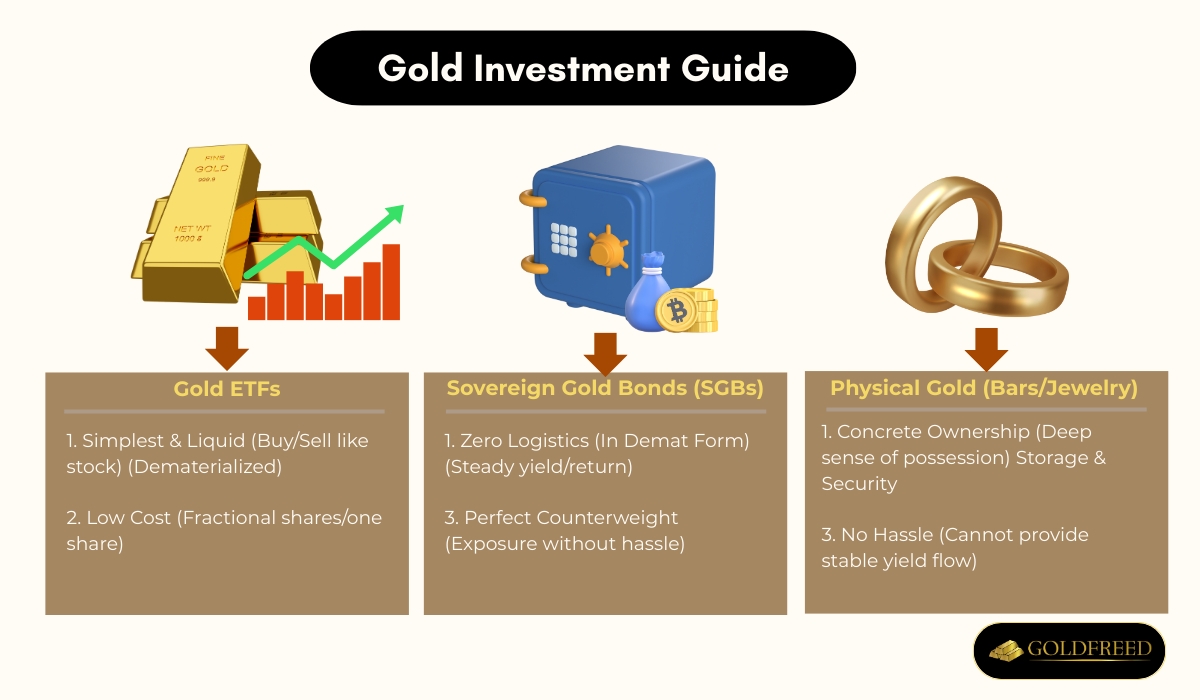
Gold ETFs and mutual funds are probably the smartest options for beginners as you can easily buy these funds in your brokerage account or retirement account, and they do not require individual company research. Gold exchange-traded funds (ETFs) are a popular way beginners can start investing in gold, yet investors can buy and sell shares of the ETF like they can a stock, gaining exposure without storing bullion.
Gold jewelry is a satisfying way to own gold, but always buy your jewellery from an original, reliable supplier and choose pieces that are at least 14-karat so resale remains transparent and easy. Physical gold requires insurance and secure storage, while gold bars and coins - commonly called bullion - are minted in smaller sizes for convenience, although dealers charge commissions and sell at a premium over spot price.
Gold futures allow leverage and are used to take physical delivery of gold, yet they are highly speculative and pose risks for beginners. Gold mining stocks provide exposure to the gold industry but do not offer pure exposure to the price of gold and remain volatile. Mismanagement of gold mining companies causes loss, and these stocks do not necessarily move in tandem with the stock market.
Diversification will not eliminate risk of loss, so approach the decision with the same care you give any financial decision, balancing ETFs, jewellery, or bullion according to your goals. Begin with a tiny doable total. Paper precious metal is appropriate for a minored first venture. Devote substantial time to understanding basic distinctions, and place schooling before assets. Create a controlled second nature of allotting a set amount periodically. Isolate yourself from the tension of short-term cost variations and keep from creating spontaneous choices. Regard the tiny tractable sum as the basis of a long-term savings scheme and maintain a long-term view.
How to build a gold investment portfolio?
To build a gold investment portfolio follow the instructions given below.
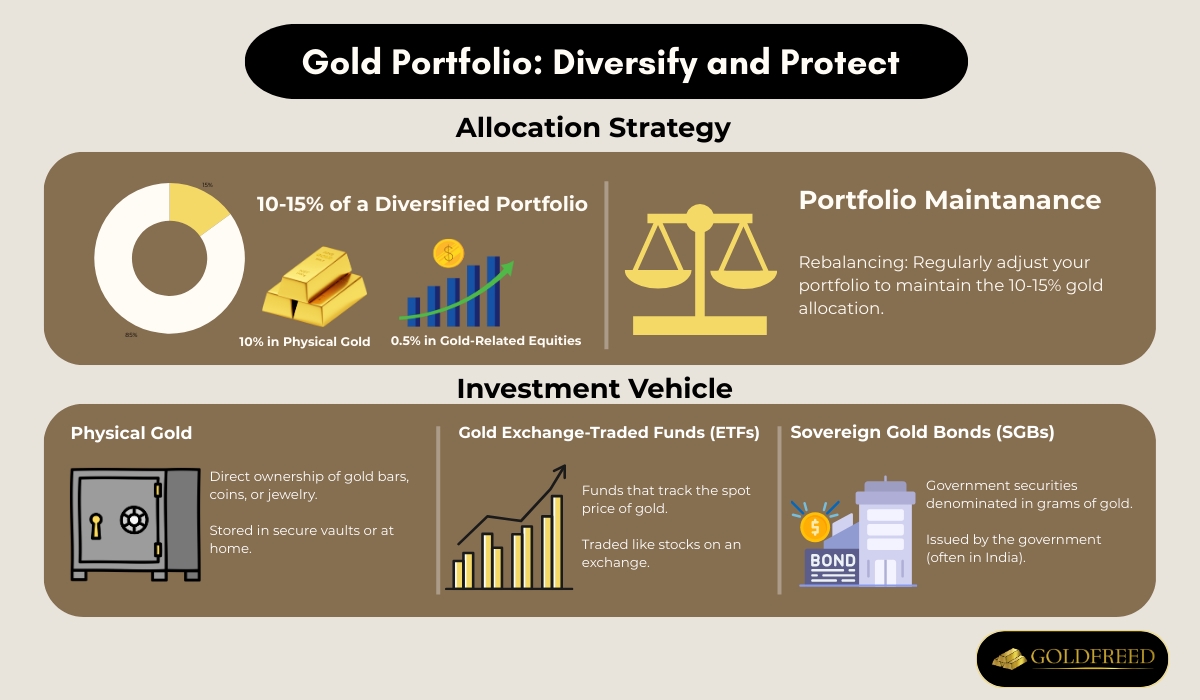
- Allocate 10% to physical gold and 0.5% to gold related equities
- Allocate 10% to 15% of a diversified portfolio to gold
- Add gold to a diversified portfolio as a hedge against production and leadership risk
- Add gold to a diversified portfolio as a hedge against liquidity risk
- Add gold to a diversified portfolio as a hedge against compliance risk, mining risk, privacy risk, environmental risk, and trade war volatility
- Buy physical gold as part of a portfolio
- Own gold mutual and exchange traded funds (ETFs)
- Buy gold as a hedge against concentration in core plus strategies, factor based strategies, hybrid management strategies, long short overlays, non core strategies and style rotation overlays
After setting the weight, choose the vehicle: investors can buy physical gold stored in vaults, or they can own gold through ETFs that track the spot price with lower expense ratios than mutual funds. Either route places gold inside a diversified portfolio as a hedge against tail-risk, liquidity-risk, credit-risk, climate-risk and cyber-risk, the same position also offsets concentration that builds up in factor-based, smart-beta or REIT-rotation overlays. Once the allocation is in place, rebalance at preset intervals so the gold sleeve stays close to its 10-15 % band, remembering that diversification does not guarantee profit or protect against loss.
My venture started with a well-defined evaluation of my financial objectives. I decided I desired a part of my funds as a protection against rising prices and market unpredictability, so I began small and allotted money across various means. One part got into sovereign precious metal securities, another part was put in a respected precious metal exchange-traded fund for its heavy fungible and simplicity of trading, and I allotted a small portion of my monthly reserves specifically for this purpose.
Thomas GoldfreburgInvestor at Goldfreed