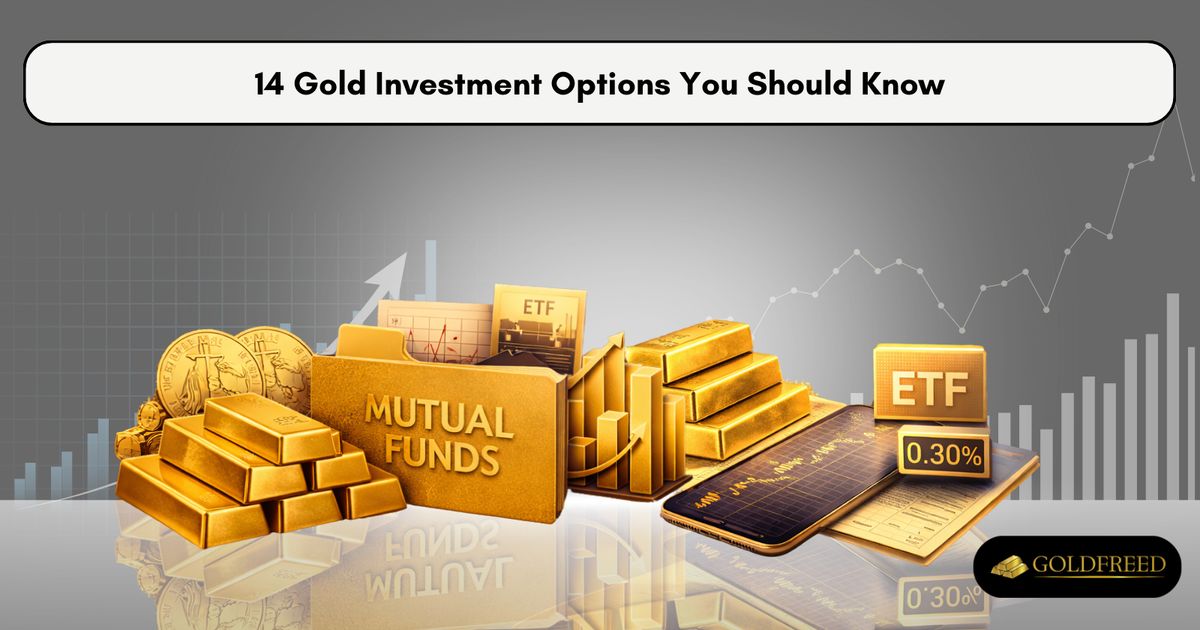
Gold offers fourteen distinct paths to ownership, each with its own risk, cost, and liquidity profile. Physical bars and coins provide direct control but incur storage and insurance fees. Jewellery blends adornment with wealth preservation yet carries high fabrication premiums. Allocated accounts segregate titled bullion in accredited vaults, while unallocated pools offer cheaper exposure without specific bars assigned. Gold-backed exchange-traded funds track the spot price and trade like shares, sparing investors custody logistics. Closed-end funds can trade above or below net asset value, adding market-price complexity. Mining equities amplify bullion moves through operating leverage and dividend potential, but also bring corporate and geopolitical risk. Streaming and royalty companies funnel production proceeds to shareholders without running mines, generating relatively stable cash flows. Futures contracts let traders magnify bets with margin, yet daily settlement demands rigorous cash management. Options on futures or ETFs provide asymmetric payoff structures for hedging or speculation. Certificates issued by banks promise metal conversion but depend on issuer solvency. Digital tokens backed by vaulted gold merge blockchain portability with physical reserves, supposing cyber-security and custodial integrity. Sovereign mint commemorative coins collect numismatic premiums that can outpace melt value, while rare historical pieces are requested by collectors. Lastly, vaulted savings plans allow incremental purchasing through smartphone apps, merging dollar-cost averaging with insured storage. Understanding liquidity, counter-party risk, storage costs, taxation, and investment horizon is necessary before choosing which vehicles fit a portfolio's strategic allocation. The 14 gold investment options you should know are listed below.
1. Physical gold
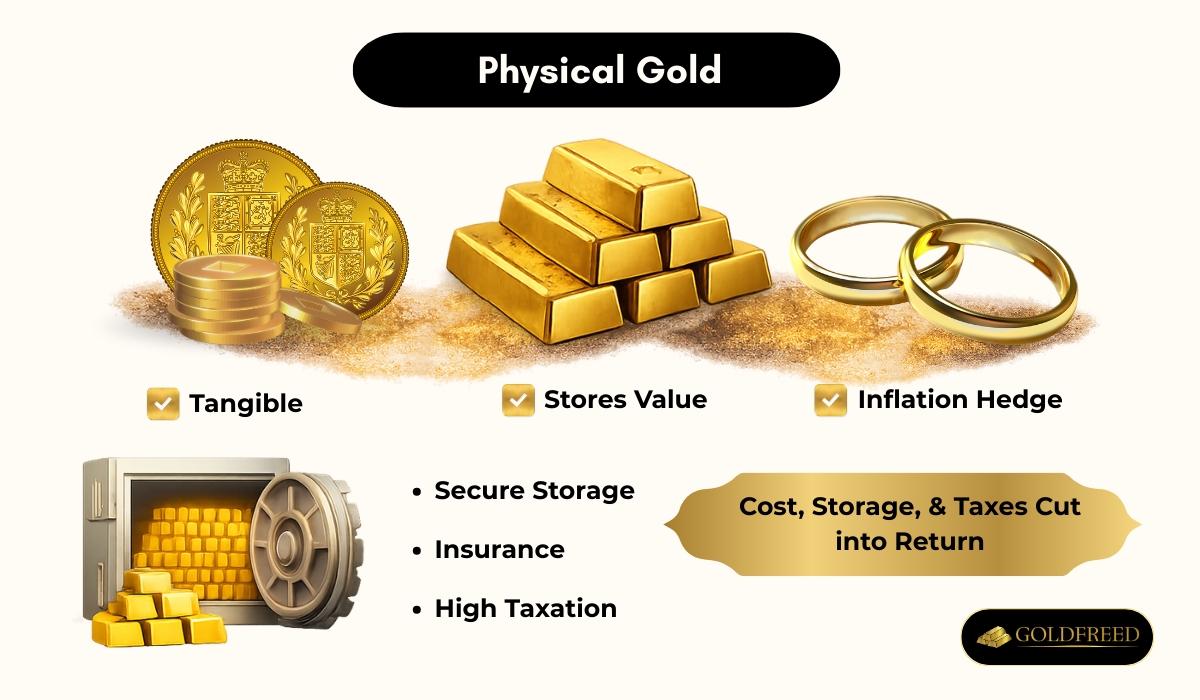
Physical gold is a tangible asset that is held as coins, bars, or high-purity jewelry. It is owned outright, carries no counterparty risk, and serves as a store of value and a hedge against inflation. Investors purchase it from the U.S. Mint, banks, reputable online dealers, jewelers, or even retailers like Costco, always paying a markup or premium over the spot price to cover manufacturing, minting, and dealer costs. Bars and coins, marked up from the spot price of gold, are the most popular ways global investors access gold, yet every purchase incurs additional costs: storage in a private vault or safe bank deposit box, insurance, and ongoing security measures. Physical gold produces no recurring income and relies solely on price appreciation for returns, so buyers are fully reliant on the commodity's price rising; when reselling, they receive less than market value. In the United States, it is taxed as a collectible at up to 28% capital gains rate, and liquidity is limited compared with digital assets or stocks.
I started with buying physical gold because I could physically own it. Holding that physical asset gave me a feel of safety, and peace of mind. It was a store of value, and a financial tool, yet with further expense: I had to secure it safely which was responsible.
Thomas GoldfreburgInvestor at Goldfreed
2. Gold futures
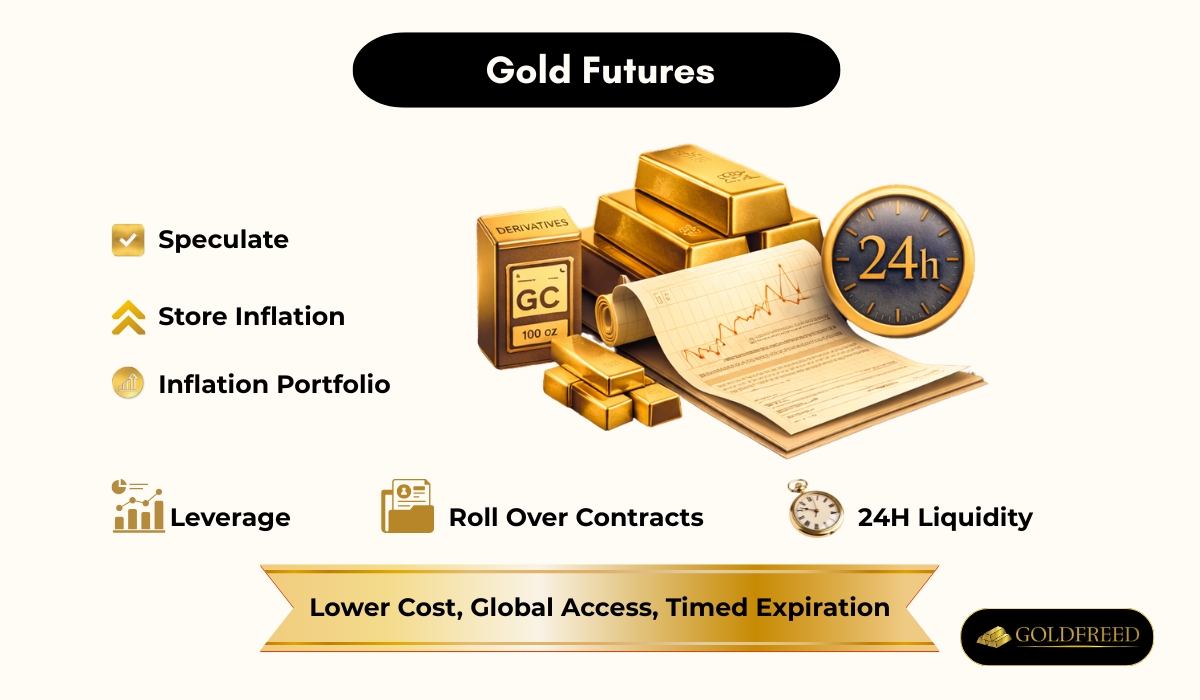
Gold futures are exchange-traded contracts that allow investors to buy or sell a specific amount of gold at a predetermined price on a specific future date . These derivative instruments are traded on the COMEX division of NYMEX and ICE under the symbol GC, with the standard contract size being 100 troy ounces, though 50 and 32.15 troy ounce contracts are also available.
Gold futures provide exposure to gold price changes without requiring physical delivery, as most traders close positions before expiry rather than taking delivery of the metal. The contracts trade nearly 24 hours a day from 6 pm to 5 pm Eastern time Sunday through Friday, with a 60-minute break starting at 5 pm, and have principal trading months of February, April, June, August, October and December.
These instruments serve multiple purposes: they allow investors to speculate on short-term moves higher or lower in the yellow metal, hedge against inflation, manage underlying risks of other securities held in their portfolio, and provide portfolio diversification due to gold's low or negative correlation to equities and bonds. Gold futures require holders to roll over contracts according to scheduled expiry dates to maintain exposure, as the contracts have defined expiration dates.
The world's leading benchmark futures contract for gold trades the equivalent of nearly 27 million ounces daily, providing high liquidity and global price discovery. Gold futures offer immense leverage that magnifies both gains and losses, with margin requirements that result in losses exceeding the initial investment. They pay no management fees compared to gold ETFs, making them a lower-cost way to invest in gold, though they require unique knowledge about the gold market and are not typically the vehicle of choice for the average investor.
My first attempt with gold futures was driven by desire to leverage my research of the market with a little fund. My experience was purely a financial tool: enabling me to control a big quantity of gold assets without necessity for physical holding. I devoted a part of my asset, and observed that the value fluctuated. Geopolitical stress induced gold prices to rise, and I witnessed the market reverse. In my opinion, gains could be attained quickly, demanding continuous attention.
Thomas GoldfreburgInvestor at Goldfreed
3. Gold ETFs
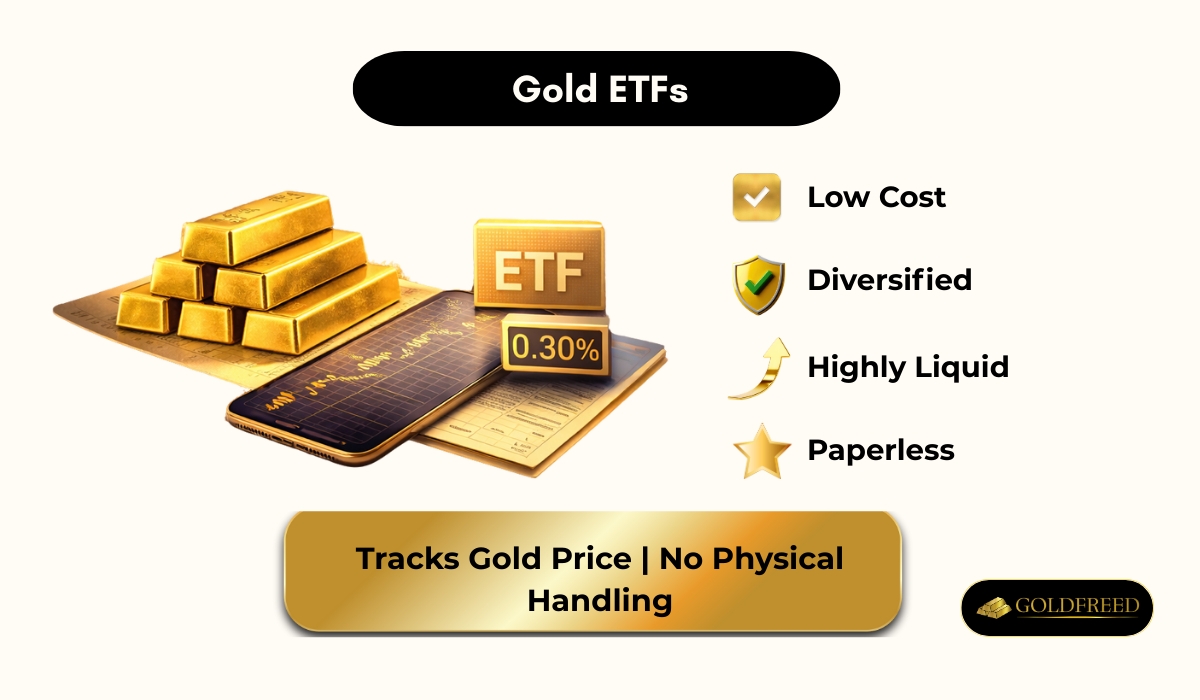
Gold ETFs are exchange-traded funds listed on a stock exchange that aim to track the price of gold by investing in 99.5% gold bullion or gold futures contracts. Each unit normally equals one gram of physical gold, yet the investor avoids storage, transportation and insurance costs. Gold ETFs are open-ended mutual funds with no lock-in period, units can be bought and sold like shares during trading hours and redeemed easily, giving deep liquidity and low bid-ask spreads.
Gold ETFs provide a cost-effective way to access gold bullion through a low-transaction-cost vehicle whose annual charges are typically under 0.30%. They give exposure to gold price movements without directly purchasing, storing or reselling the metal, and they reduce concentration risk by offering a diversified portfolio of gold assets. Because holdings are disclosed regularly, investors can check real-time quotes and rebalance exposures quickly.
Since their launch in 2003, Gold ETFs have grown to record levels, global assets reached US $286 billion and over 3,500 tonnes of gold were held in gold-backed ETFs by the end of 2022. Net inflows returned in 2024 with US $3.4 billion added after three prior years of outflows, and strong interest during the first three quarters of 2025 pushed total assets to $222 billion. Gold ETFs are used as a safe haven during market volatility, a hedge against inflation and currency fluctuation, and sometimes as collateral security.
Main types of gold ETFs include those that are physically backed, miners, inverse, leveraged, smart beta and currency-hedged. Physically backed funds hold gold bullion in a trust, while synthetic products use swaps or futures. Inverse and leveraged versions seek opposite or multiple exposure to daily gold price moves, and currency-hedged share classes protect against exchange-rate risk. Expense ratios range from 0.10% to 0.30%, IAUM carries the lowest fee, GLD offers tight bid-ask spreads, and UGL provides 2 daily leverage. Investors can buy gold ETFs through any brokerage or commission-free platform, hold them in a Demat or ISA/SIPP, and set up regular savings plans. In the United States long-term capital gains are taxed at 28%, and in India units held for more than three years qualify as long-term capital gains while shorter periods are taxed as short-term gains.
I tried gold ETFs searching for liquidity. The procedure was easy, without the logistical concerns of physical storage, and I could buy or sell units at existing stock exchange prices during trading times, offering an extent of adaptability that physical gold cannot give. This digital form of gold suited my choice for a paperless and efficient financial way.
Thomas GoldfreburgInvestor at Goldfreed
4. ETF based on gold company shares
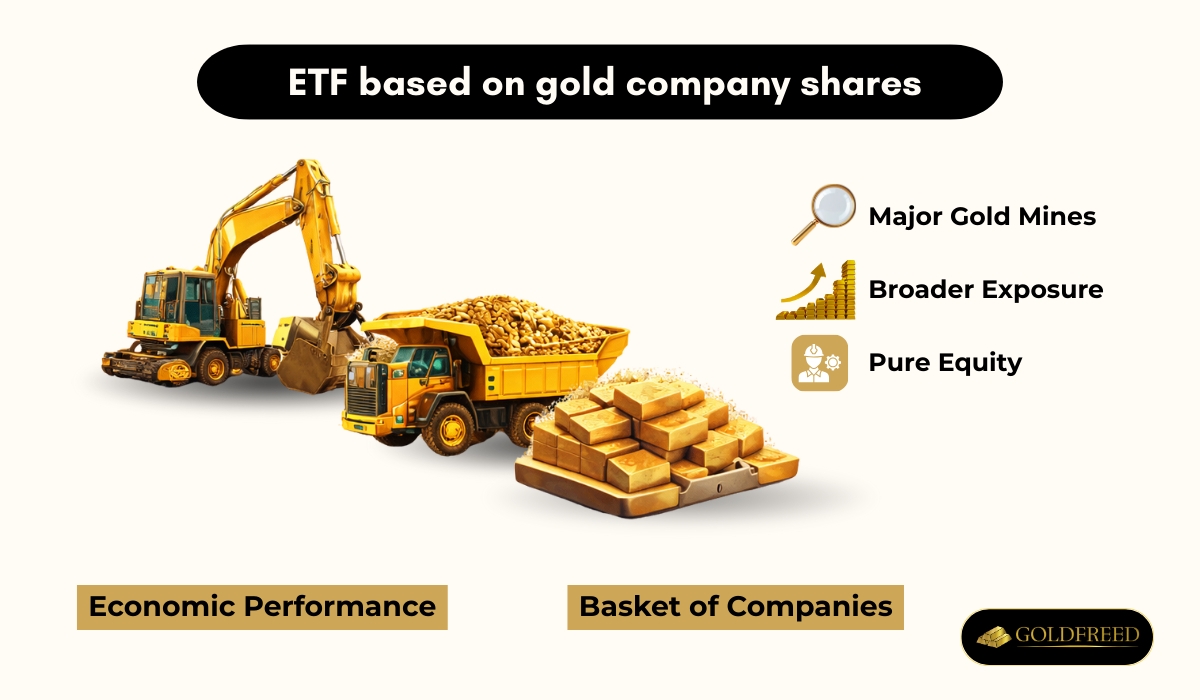
A gold ETF tracks the evolution of shares of companies in the gold sector. VanEck Vectors Gold Miners ETF is the largest ETF focused on holding shares of major gold mining stocks, its ticker is NYSEMKT:GDX. The issuing company buys stock in gold-related companies, so the buyers own a basket of miners rather than metal.
I started to use an ETF based on gold company shares to acquire an exposure to the broader mining market. I have noticed that its function is not bound to the spot cost of precious metal, instead, it shows the functional economic and performance of the mining companies. Consequently, the investment trust's value gives both gains and declines, and I have viewed the investment company's price respond further precipitously than the cost of precious metal itself. Buying stocks through my account was straightforward, like purchasing any share.
Thomas GoldfreburgInvestor at Goldfreed
5. Gold mutual funds
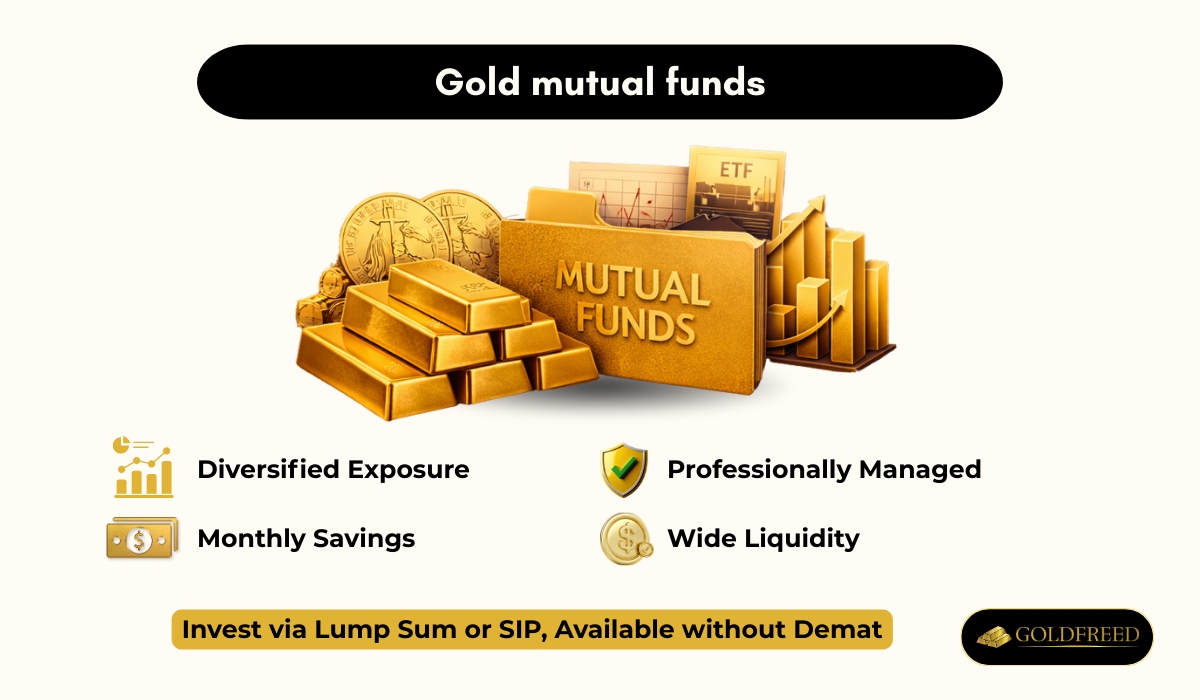
Gold mutual funds are a type of mutual fund that invest in gold ETFs, physical gold, and gold mining companies. Investors can gain exposure to gold without having to hold physical gold directly. They pool money from many investors and create a diversified portfolio of assets that have a strong correlation to various segments of the gold market. The objective is to generate potential long-term wealth linked to the performance of gold as a commodity and create value by riding fluctuations in gold prices. Investments are professionally managed, and the units carry daily liquidity similar to gold ETFs. There is no need for a Demat account, which makes them more accessible to investors. Most fund houses also offer a systematic investment plan (SIP) option for regular savings.
Gold mutual funds are open-ended, and their net asset value is calculated at the end of each trading day, the NAV changes as market prices move. Their performance is sensitive to gold price movement and carries management risk, but the disciplined structure offers some measure of stability. The twin benefit of gold price-linked investment and the liquidity and management typical of mutual funds is the primary attraction. Investors pay an expense ratio that ranges between 0.5% and 1% for most funds, with some passive funds costing even less. In a fund-of-fund structure, the scheme bears its own expense ratio plus that of the underlying gold ETF, so one must look out for the combined cost. An exit load applies if units are redeemed within a specified period, one year, and in India the investment is treated as a non-equity product for tax purposes, with gains taxed at the slab rate on redemption.
Popular funds include Tocqueville Gold (TGLDX), Gabelli Gold Load-Waived (GLDAX.LW), Gabelli Gold Fund (GOLDX), Invesco Gold and Special Minerals Fund, Fidelity Select Gold Portfolio Fund (FSAGX), American Century Global Gold Fund, First Eagle Gold Fund (SGGDX), and Victory Capital Precious Metals and Minerals Fund (USAGX). Portfolios frequently carry large positions in miners like Newmont Corporation, Agnico Eagle Mines, Kinross Gold, and Wheaton Precious Metals Corp. Holdings include small allocations to cash, cash-equivalents, or debt instruments to manage liquidity. Shares can be bought through lump-sum payments or via SIP, and units can usually be redeemed quickly through the fund house or on the stock market.
Gold mutual funds pool capital into portfolios managed by a respected investment firm, so I allocated a part of my monthly savings. Because its price acted independently of the equity of the stock market, my asset kept value during periods of economic uncertainty. I noticed that the asset value offered a balance and reassurance. This ordeal reinforced my truth in non-correlated investments as a major and stabilizing part of my portfolio.
Thomas GoldfreburgInvestor at Goldfreed
6. Digital gold
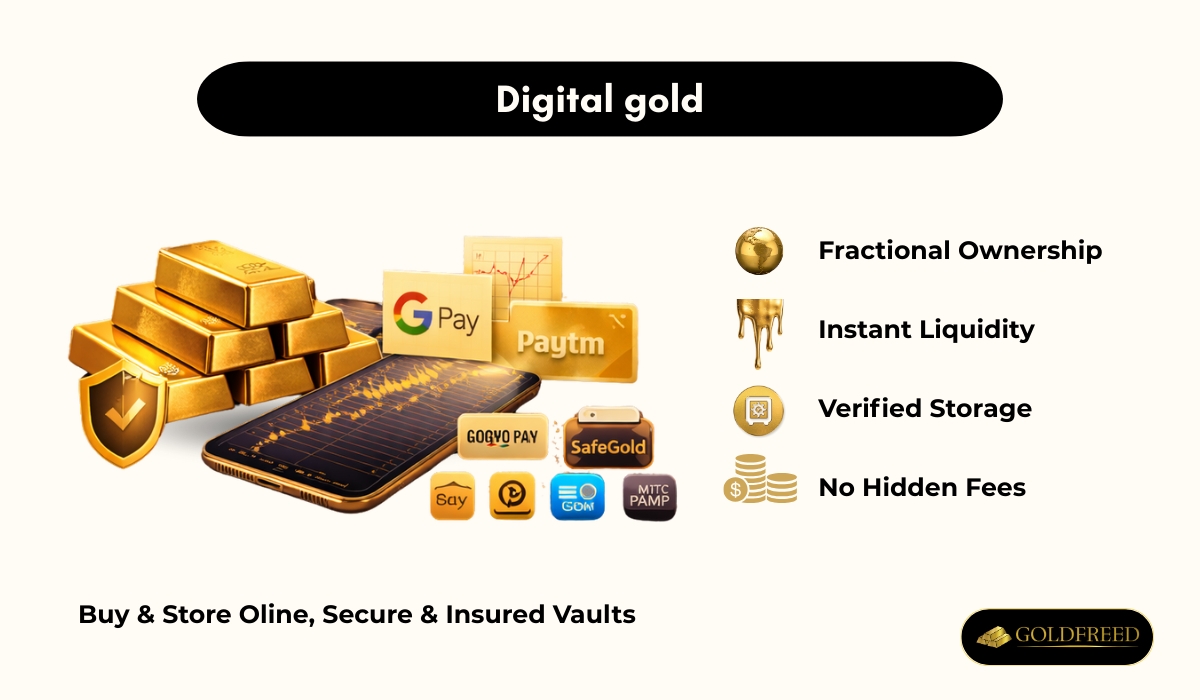
Digital gold is a modern way to invest in the yellow metal without buying physical gold bars or coins, it represents ownership of 24-karat physical gold stored in secure and insured vaults, yet it is held and traded in an electronic format. Because digital gold allows investors to purchase and hold fractional quantities through online platforms, it offers the same underlying value as physical gold but in a more accessible and flexible form. Investors can buy, sell, or hold digital gold in seconds, using apps: Google Pay, Paytm, Amazon Pay, SafeGold, Augmont Gold, or MMTC-PAMP, and the price tracks the real-time market rate. Digital gold thus eliminates the need for storage, insurance, and purity verification, while providing instant liquidity and a risk-free storage facility, and it incurs a 3% GST on every purchase and short-term capital-gains tax if sold within three years, after three years, long-term capital gains tax is levied at 20% with indexation benefits.
Digital gold lets me buy it starting one dollar, so I could buy precious metal whenever I needed. My first attempt was caused by curiosity: the ability to collect gram by gram felt meaningful. Each trade concluded at stock exchange prices, with proceeds transmitted immediately to my bank account. When I sold through the app, I discovered the procedure was straight and simple. Digital gold combines transparency and liquidity.
Thomas GoldfreburgInvestor at Goldfreed
7. Gold mining stocks
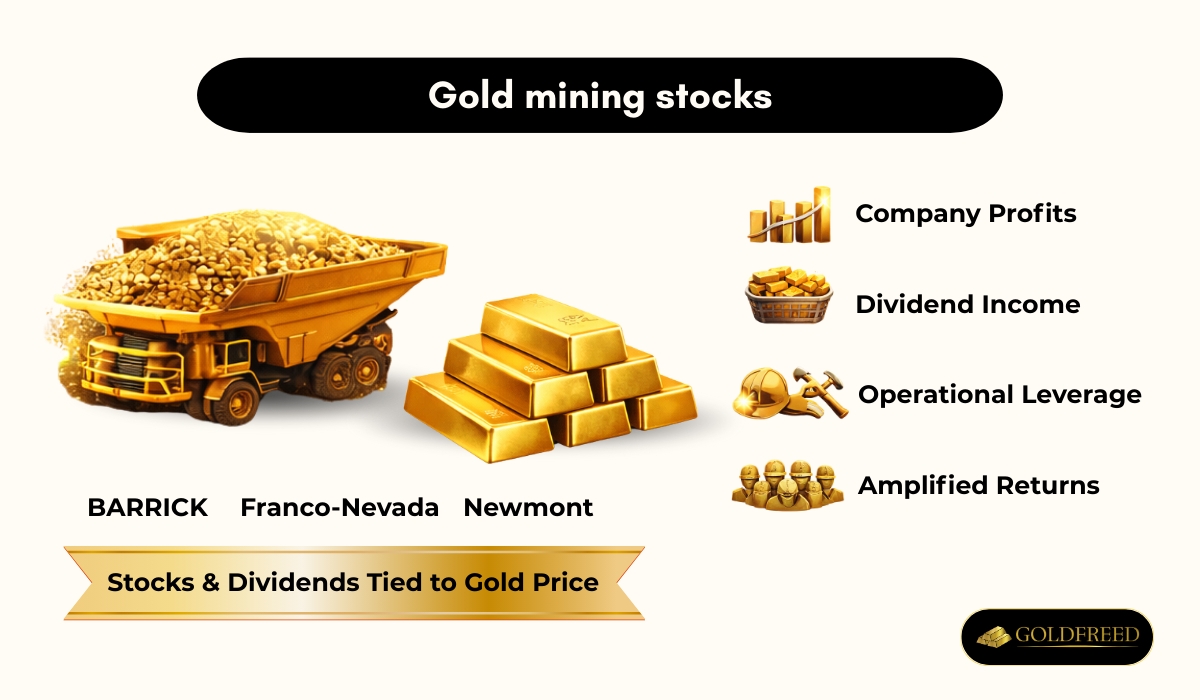
Gold mining stocks are shares of publicly-traded companies involved in gold production. These shares give investors exposure to the gold industry without owning physical gold, while adding the potential benefits and risks of business ownership. Miners have fixed costs, so gold mining stocks amplify profits when gold prices rise. Operational leverage ensures profits rise faster than gold prices. Because of this leverage, gold mining stocks deliver higher returns than physical gold during gold price increases, yet they are riskier due to company and operational factors like mine growth cost overruns, financial issues, and mismanagement. They underperform gold when such problems arise.
Gold mining stocks can be purchased on major U.S. exchanges or the Toronto Stock Exchange, and their performance is measured by indexes like the NYSE Arca Gold Miners Index, a modified market-capitalization-weighted basket of publicly traded companies involved primarily in mining for gold and silver. Individual miners range from senior producers, for example, Newmont Corporation, the world's largest gold mining corporation with operations on five continents, to explorer companies listed on the S&P/TSX Venture Composite Index. Investors seeking diversified exposure can buy the GDX fund, which spreads risk across multiple large- and mid-size miners. Analysts suggest looking for a top-tier gold miner that has a low-cost structure, manageable debt level, visible production growth profile, and limited exposure to risky mining projects. Barrick Gold, with operations in the United States, Tanzania, Canada, the Democratic Republic of Congo, Mali, and Argentina, stands out among top gold mining stocks after reporting record EBITDA in 2024 and a 51% gain in adjusted net earnings. Franco-Nevada, a Canada-based streaming and royalty company, provides stable cash flow through royalties and streaming agreements, reducing the risks of mining cost overruns while still offering leveraged exposure to gold prices.
Gold mining stocks benefit from inflation or economic uncertainty and act as a hedge against extreme uncertainty, with most advisors allocating 5% to 10% of a gold position to high-quality miners. They have low price-correlation with major stock indexes, thereby lowering a portfolio's risk profile, although they are more volatile than physical gold and are impacted by geopolitical, environmental, regulatory, and ESG considerations. Dividend income is possible but rarely stable because of the cyclical nature of the business. In short, gold mining stocks offer a way to benefit from higher gold prices, but they require careful stock selection and position sizing.
Gold mining stocks are linked to the company’s functioning. Quarterly reports demonstrated stable production, and functional records showing a steady growth, yet a major fail at principal properties caused a sudden and sharp fall in price. I saw decades of profits vaporized in months when the organization faced heavy liability.
Thomas GoldfreburgInvestor at Goldfreed
8. Gold coins
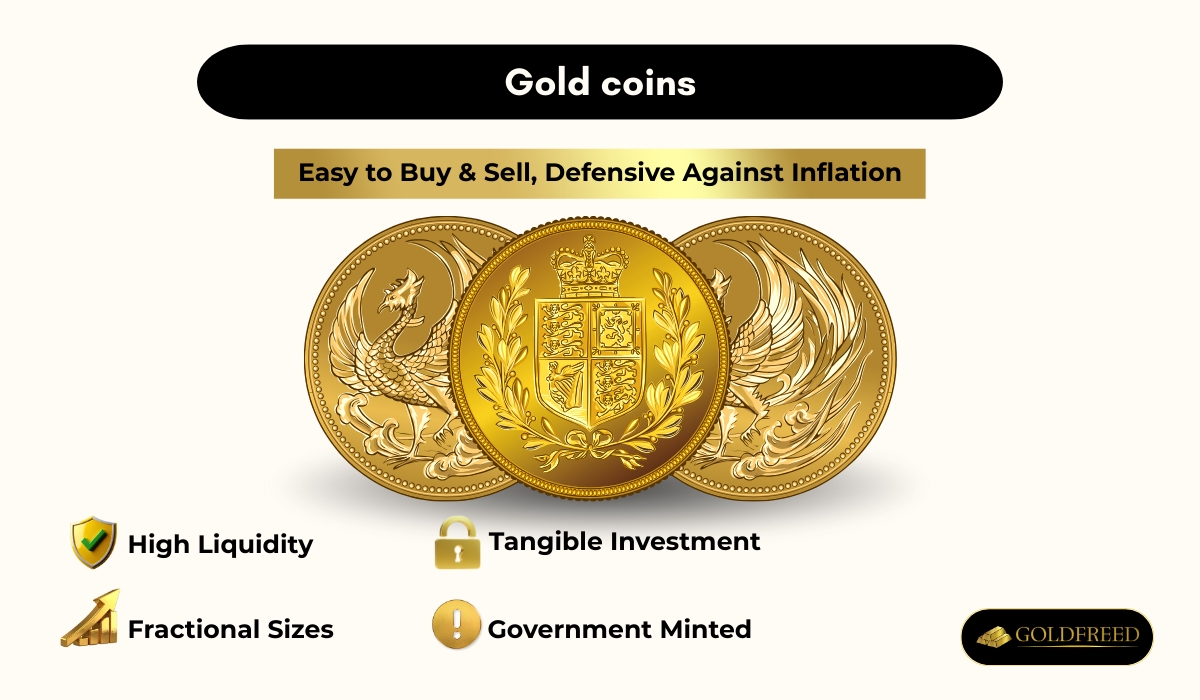
Gold coins are legal tender of their issuing country; American Eagle, South African Krugerrand and Canadian Maple Leaf are the most widely circulated examples and therefore the most practical for maximum liquidity. Minted by the government, these coins carry recognized value globally, are easy to sell, and come in fractional weights, giving flexibility for first-time and seasoned investors. As tangible assets, they offer direct ownership, high liquidity, accessible purchase sizes and government mint certification, while their aesthetic attraction and sometimes collectible value turn them into dual-purpose assets that outperform bullion.
Despite these strengths, gold coins obviously require safekeeping-either a home safe or a bank safe-deposit box-and are insured, buyers pay a premium over spot price when a coin carries collector's value. Still, coins remain easier to buy and sell than bars, are bought from reputable online gold dealers or collectors, and are widely accepted as a defensive investment and hedge against inflation.
I started gold investing with a couple of gold coins, which inherent value was felt firm and comforting in my hand. I began choosing coins with unusual designs and medallions, which brought a level of individual enjoyment. I understood that keeping them securely became a priority, and I regarded it not as a problem but as a critical part of responsible ownership.
Thomas GoldfreburgInvestor at Goldfreed
9. SPDR Gold Shares
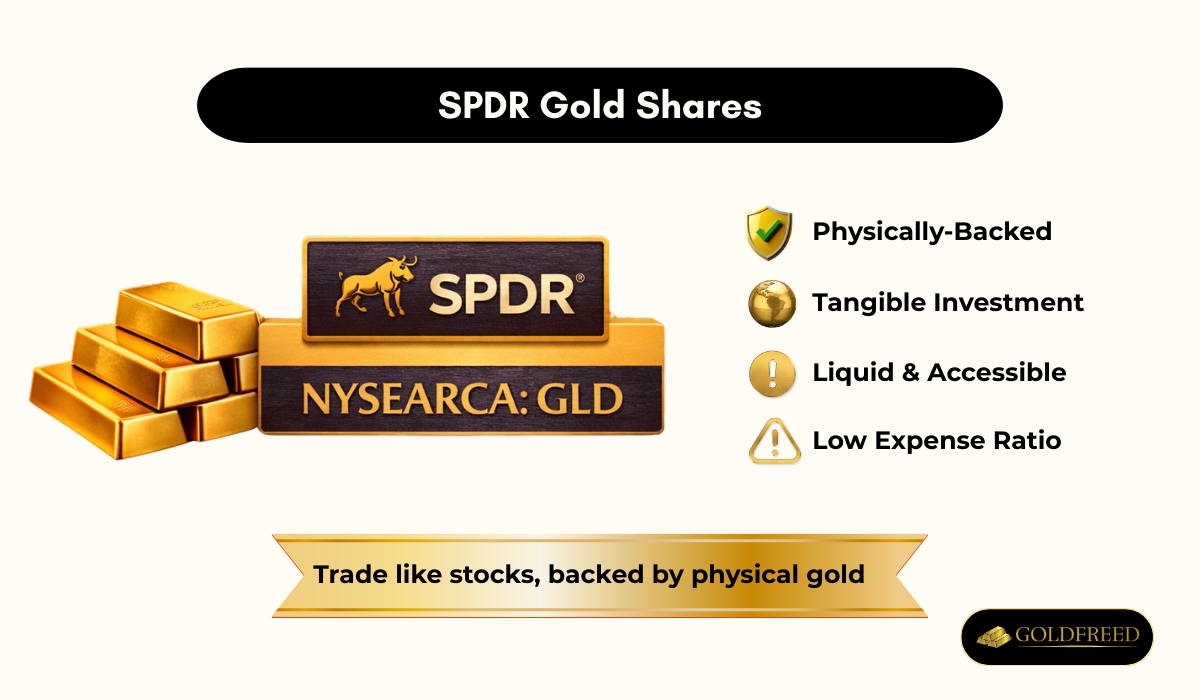
SPDR Gold Shares are the largest physically backed gold exchange traded fund. SPDR Gold Shares (NYSEArca: GLD) offer investors an innovative, relatively cost efficient and secure way to access the gold market. GLD was originally listed on the New York Stock Exchange in November of 2004 and is now quoted on NYSE Arca under ticker GLD, the same security is cross-listed on the Singapore Stock Exchange (ticker GSD.SI), the Tokyo Stock Exchange, the Stock Exchange of Hong Kong (ticker 2840) and the Mexican Stock Exchange (BMV). Investors can buy and sell SPDR Gold Shares through a standard brokerage account exactly like a listed equity, and shares trade like stocks with an average daily bid-ask spread of 0.01%. The gold that underlies SPDR Gold Shares is held in the form of allocated 400 oz (11.34 kg) London Good Delivery bars in the London vaults of HSBC Bank USA, N.A., giving the product institutional-grade security. The Trust is structured as a grantor trust, sponsored by State Street Global Advisors and administered by The Bank of New York Mellon as trustee, the trustee handles creation and redemption of orders for the Trust's shares with Authorized Participants, who deal in blocks of 100,000 SPDR Gold Shares each a Creation Unit . The Net Asset Value of SPDR Gold Shares is determined each day that NYSE Arca is open for regular trading, and the Trust adopts the LBMA Gold Price PM as its reference benchmark price. GLD charges an annual expense ratio of 0.40%, has a tracking error of 0.0004 from 01/01/2011 to 10/31/2024, and currently holds roughly $80 billion in assets, making it one of the most liquid and widely held gold vehicles in the world.
My first attempt into SPDR Gold Shares (GLD) was driven by a wish for a direct ownership of physical gold without the intricacies of storage and insurance that had discouraged me when I examined physical gold investment. It was as easy as purchasing a share through my profile account, and each share in the bank was held in safe vaults. This model gave the physical asset backing I requested, and maintaining GLD within my portfolio has worked as a non-correlated advantage during times of market volatility. The value of my GLD allocation stayed steady, and this experience built my assurance in its capacity as a strategic diversifier.
Thomas GoldfreburgInvestor at Goldfreed
10. Gold options
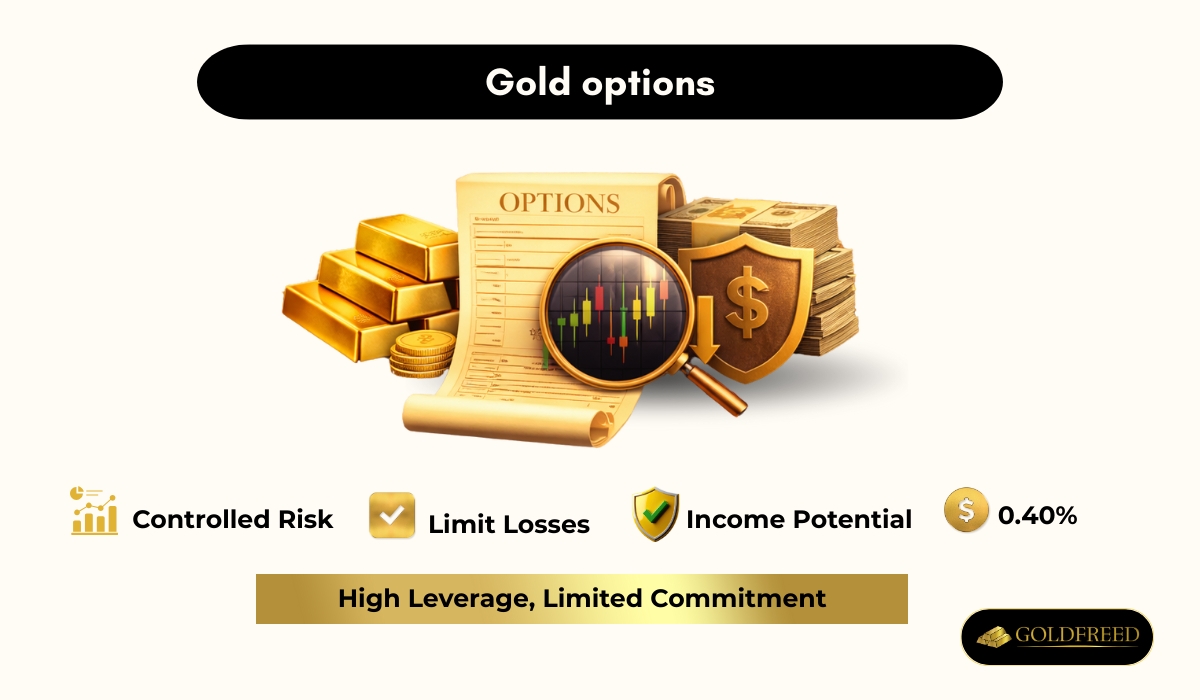
Gold options are contracts that give the investor the right, but not the obligation, to buy or sell a futures contract at a specific price before it expires. They differ from futures in that the holder lets the contract lapse, limiting loss to the premium paid. Each option has a strike price, a premium cost, and a fixed expiration date. Investors use gold options to hedge against potential price drops or to generate income through strategic selling. Because the commitment is limited to the premium, gold is bought with controlled risk exposure, making the instrument attractive to balanced investors who allocate 5-10% of assets to gold.
Gold options let me manage a big quantity of gold while I hedge an existing position. I allocated merely a small, speculative part of my portfolio, purchasing puts as a type of protection during times of market instability. I strictly avoided writing options due to the possibility of infinite losses risk. Being complex and risky, yet I recognize they are advantageous and intellectually attractive, though, not a main system for creating long-term wealth in gold.
Thomas GoldfreburgInvestor at Goldfreed
11. Gold bullion
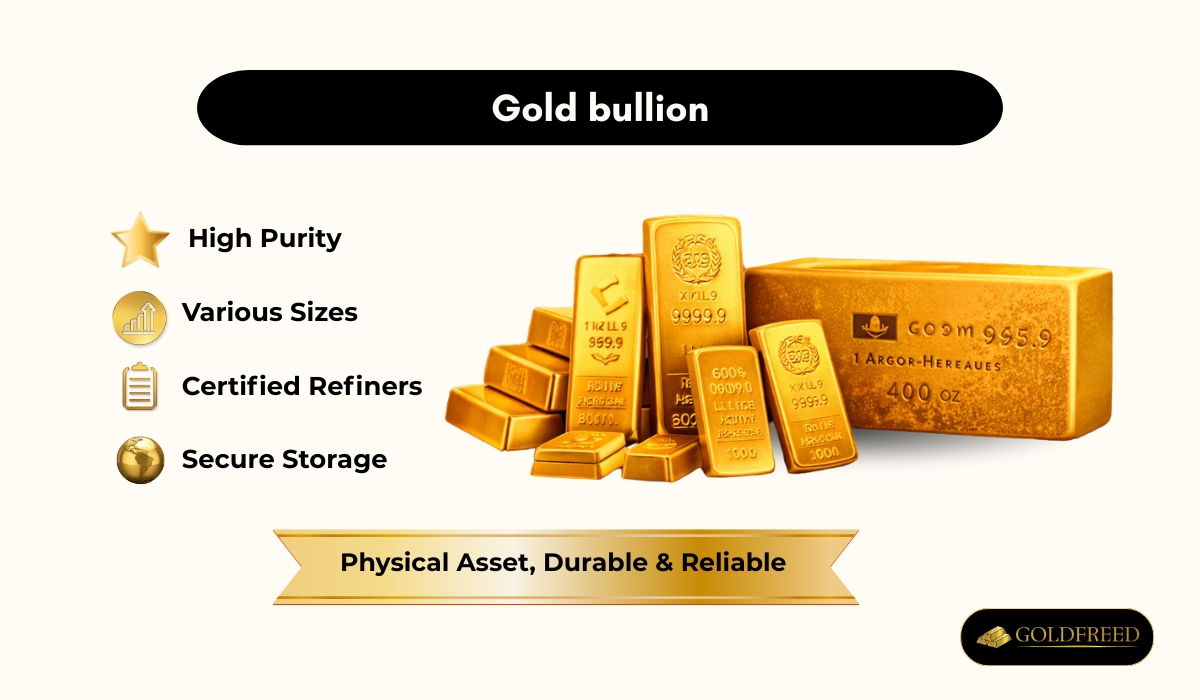
Gold bullion is the name given to gold bars that are sold by weight and stamped with purity, weight, and manufacturer details. The international standard demands that investment-quality bars be at least 99.5% (995) pure gold, refiners, for instance, Valcambi and Argor-Heraeus routinely cast 99.9% (999.9) bars. Sizes range from 1 gram (0.035 ounces) to 1 kilogram (2.2 pounds), while the cost-effective wholesale Good Delivery bars cast by LBMA-approved refiners weigh about 400 ounces (12.5 kilograms) and come with a warranty of quality and authenticity traced back to the refiner.
Large-bar gold is normally stored and insured in specialist vaults, and the same secure storage, bank safe-deposit box, or home safe is used for smaller bars. Because bullion derives its value solely from gold content, it pays no interest or dividends and needs no close watching like a portfolio of stocks, mutual funds, ETFs, or bonds. Investors holding bullion obtain a physical asset that provides stable value, insurance for wider investments, and a hedge against inflation within a balanced portfolio.
Gold bullion is a tangible and immediate type of gold I can hold in my hand, offering protection that paper investments or digital assets cannot. This is a long-term store of value and financial insuarnce against systemic uncertainty. Buying from respected vendors ensures authenticity. Logistics cost are taken. I acknowledge security and confidence of holding a gold bullion.
Thomas GoldfreburgInvestor at Goldfreed
12. Gold jewellery
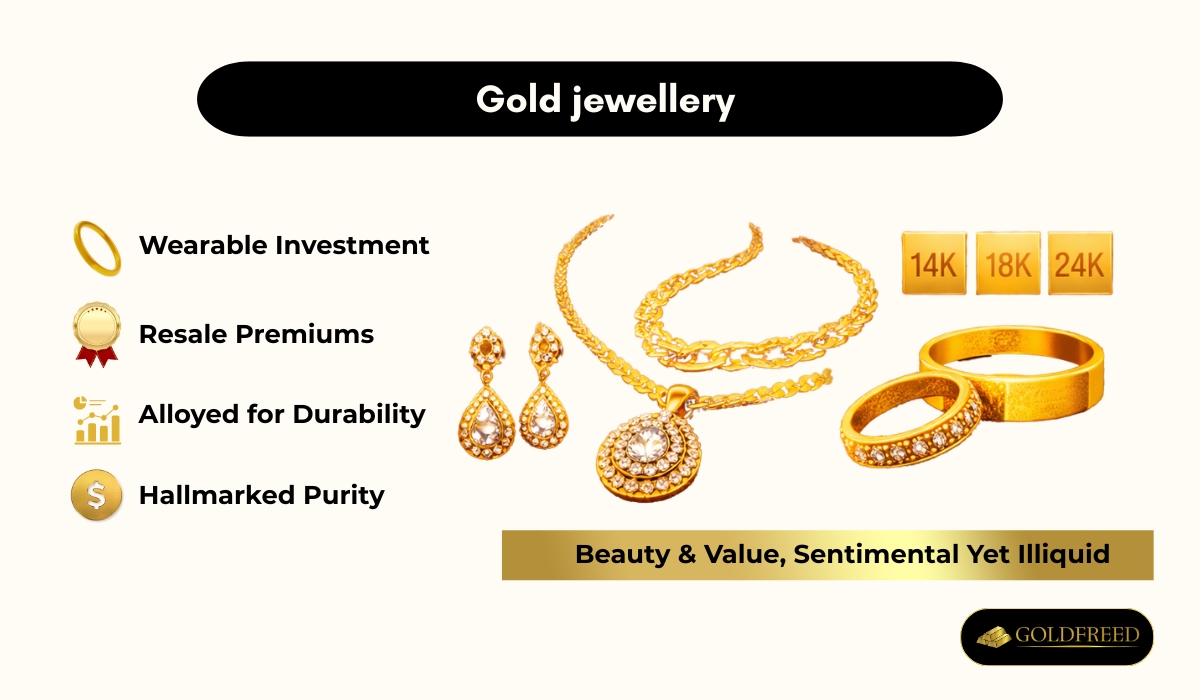
Gold jewellery is a wearable form of gold that blends beauty and value. Most pieces are alloyed: 14-karat items contain 58.3% pure gold and 41.7% other metals, while 18-karat items contain 75% gold and 24-karat (pure gold) pieces contain 99.9%. These mixtures increase durability and reduce cost, making jewellery more practical for daily wear.
Consumers normally pay a retailer markup of roughly 100% above wholesale cost, plus making charges. Because of this initial premium, resale usually yields only about 50% of the original purchase price. Shops that buy gold, typically pay 30-50% below the prevailing spot value. Value is therefore driven primarily by current gold price, weight, and actual gold content, although design, craftsmanship quality, and brand name influence a buyer's premium. A hallmark stamp: 14K, 18K, 22K, 583, or 585 - identifies alloy purity and is shown on every piece. Jewellery is VAT-free under U.K. investment-grade standards ( 99.5% purity), lower-purity ornaments attract VAT.
To buy prudently, investors: - Seek pieces priced near melt value - Ask for documentary proof of purity and weight - Compare prices online or at large retailers - Review at consignment shops or pawn shops
Because pieces are stored safely, worn daily, and passed down as heirlooms, gold jewellery functions as a long-term store of value and a small, liquid part of a diversified portfolio when acquired at a fair price and maintained with proper cleaning, repair, and storage.
Gold jewelry serves as both ornament and a store of value. I see gold jewelry as a property treasured for its craftsmanship and personal significance, yet its worth as an investment is reduced by making costs and heavy charges. Jewelry is a sentimental and decorative, and I acknowledge the emotional worth it holds, but absence of liquidity makes it an ineffective asset for financial purpose. Gold jewelry is not an important part of my financial strategy.
Thomas GoldfreburgInvestor at Goldfreed
13. Sovereign Gold Bonds
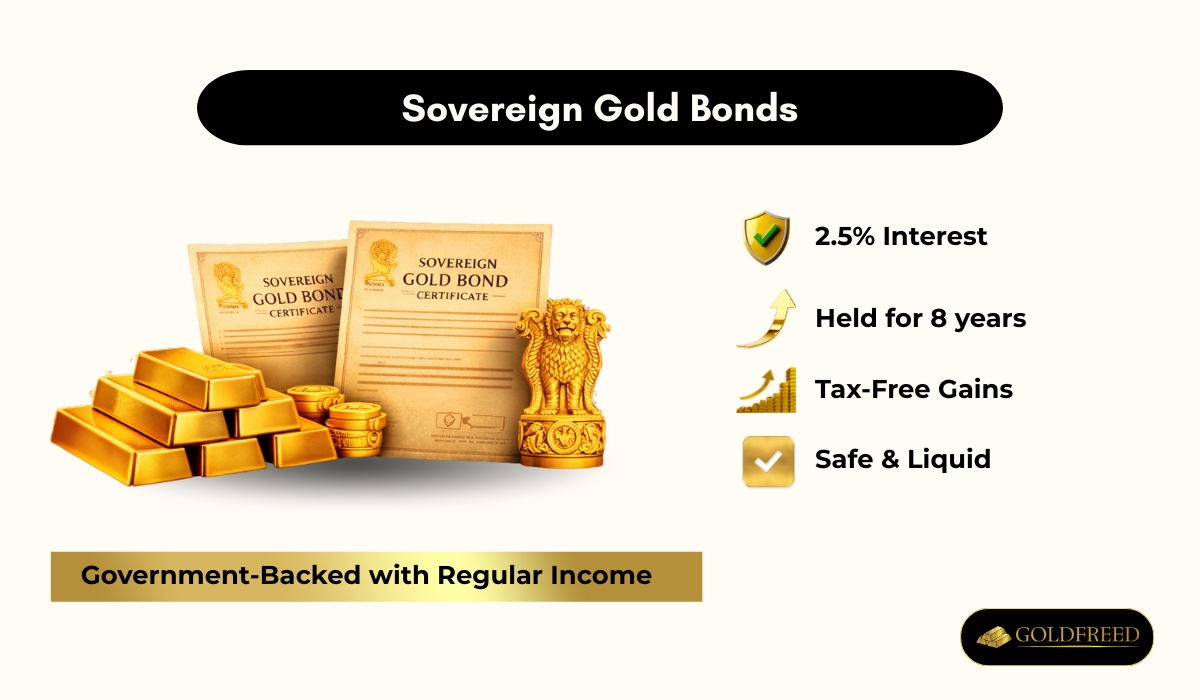
Sovereign Gold Bonds are government securities issued by the Reserve Bank of India on behalf of the Government of India and denominated in multiples of gram(s) of gold with a basic unit of 1 gram (0.035 ounces). Launched in November 2015 under the Gold Monetisation Scheme, the eight-year bond carries a fixed interest rate of 2.5% per annum paid semi-annually, and offers an exit option after the fifth year that is exercised only on scheduled interest payment dates. The issue price of each new tranche is set by taking the simple average of the 999-purity gold closing price for the previous three business days published by the India Bullion and Jewellers Association Ltd, online applicants automatically receive a discount of Rs 50 per gram. At maturity, or on premature redemption after five years, the investor receives the prevailing market value of gold, again calculated as the three-day average IBJA price, and the entire capital gain is exempt from tax provided the bond is held until maturity. Resident individuals, HUFs, trusts, universities and charitable institutions subscribe up to 4 kg (8.82 lbs) or 20 kg (409 lbs), of gold respectively per fiscal year, the minimum investment is 1 gram (0.035 oz). The bonds are purchased through scheduled commercial banks, SHCIL, designated post offices, stock exchanges and online portals, are held in demat form, and become tradable on the NSE and BSE after the statutory 14-day lock-in from the subscription date. No storage costs, no purity risk, no TDS on interest, and the ability to use the bond as collateral for loans complete the product feature set.
Sovereign Gold Bonds appealed to me as the concept of having gold without the worries of storing and safety concerns that come with tangible bars or jewelry. I applied online during the authority's issuance period through my bank, the program procedure was clear. After verifying my credentials, I electronically perceived a modern and effective model of gold purchase. These services provide a yearly interest payment that is immediately credited to my account, offering a predictable accumulated income. Carrying these bonds offered a feel of financial stability and a safer option to other volatile assets.
Thomas GoldfreburgInvestor at Goldfreed
14. Gold certificates
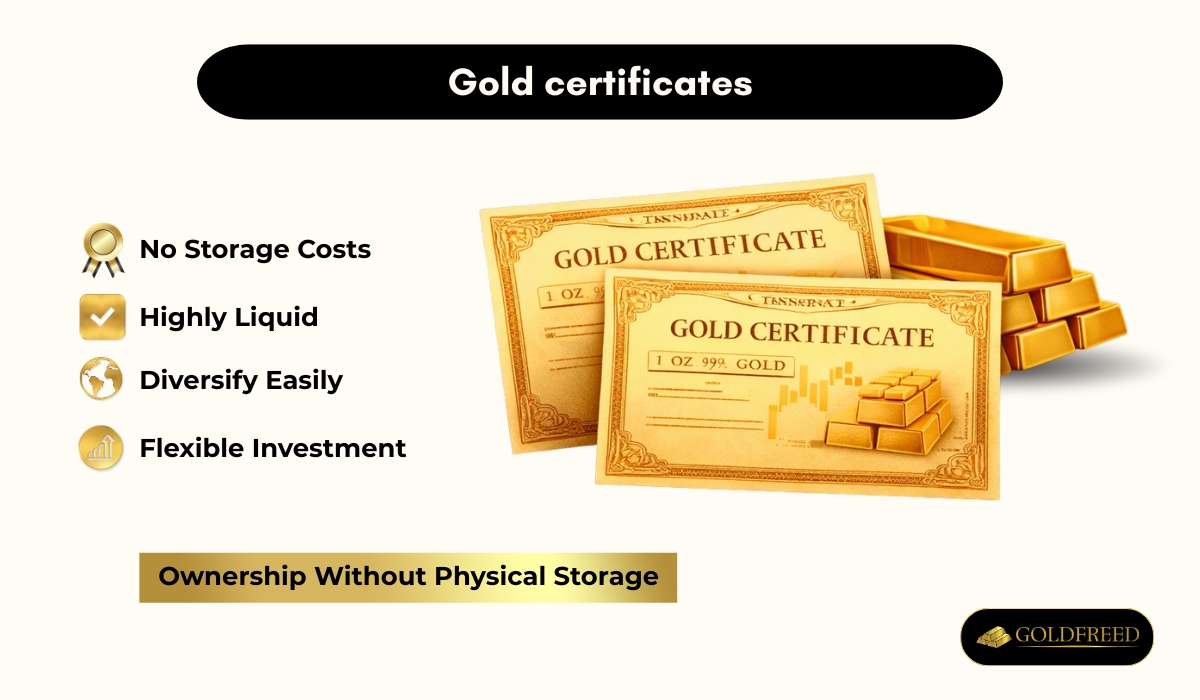
Gold certificates are financial instruments that represent ownership of a certain amount of gold. These certificates are similar to the world's first ever paper bank notes, functioning historically as receipts proving that you deposited gold with a bank. Modern gold certificates are primarily financial instruments, exposing investors to gold price movements without requiring physical storage or security concerns. A gold certificate gives you exposure to the price of gold without physically owning the metal, offering a convenient alternative to the burden of holding physical bars.
Gold certificates are often issued by banks, Swiss banks, German banks, or other financial institutions that own the underlying gold. In the US, gold pool programs continue to issue gold certificates. These certificates are typically unallocated gold but carry an option to convert into allocated gold at the investor's option-though this conversion often comes at considerable cost.
The value of your certificate moves directly with the price of gold, subject to price volatility risk. Gold certificates provide high liquidity and make it easier to diversify assets, making them suitable for flexible savings, short term hedging, or frequent transaction needs. You can buy or sell gold certificates through a securities account on financial markets. Though gold certificates cannot be used to buy things and are subject to tax implications, they remain an affordable, lower risk way to add gold to your portfolio.
Gold registered security comprise a robust option. My ownership is not of material gold, but a certificate from a financial organization. I value convenience, yet my view on gold investment was changed by counterparty danger.
Thomas GoldfreburgInvestor at Goldfreed
Expert behind this article

Thomas Goldfreburg
Thomas Goldfreburg is a gold investment advisor, author and founder of Goldfreed. Thomas's expertise is built on an academic foundation of a Bachelor of Science in Economics from Stanford University and complemented by market experience. Thomas specializes in gold IRA, ETF, 401k, and physical gold investments.