Gold ETFs deliver a cost-effective, liquid alternative to holding the metal outright, trading instantly on stock exchanges through your demat account while maintaining transparency, yet they carry expense ratios that can exceed those of non-commodity funds and involve gold of 99.5% purity sourced by fund houses from banks.
Digital gold lets investors buy, sell, hold and trade 99.9% 24K pure gold electronically without storage fees, whereas physical gold gives tangible possession of the gold but demands secure storage that requires careful planning and may incur costs.
Choose ETFs if you value liquidity and simplicity; choose physical gold for the peace of mind that comes from direct control of a tangible asset.
Expert behind this article

Thomas Goldfreburg
Thomas Goldfreburg is a gold investment advisor, author and founder of Goldfreed. Thomas's expertise is built on an academic foundation of a Bachelor of Science in Economics from Stanford University and complemented by market experience. Thomas specializes in gold IRA, ETF, 401k, and physical gold investments.
ETF vs physical gold: Which is a better investment?
| Investment Type | Details |
|---|---|
| Physical Gold | Treated as a collectible;Used as a hedge against inflation and deflation;Can be bought using a credit card;Storage costs included in cost comparison;No annual management fees;Dealer commissions included in cost comparison;Less liquid compared to ETF shares;Tax implications vary depending on specific investment. |
| Gold ETF (e.g., IAU, GLD) | ETF shares are a type of fund share;Annual management fees range from 0.25% to 0.40%;Fees gradually erode holdings over time;Shares can be bought or sold during market hours;More liquid than physical gold;Hidden fees may include brokerage fees;GLD returned about 99.3% over five years;One-year returns for major ETFs ranged from 44% to 46%;Investors can invest with every paycheck; Tax implications vary depending on the specific investment. |
| Decision Factors | Should depend on investment goals, risk appetite, personal circumstances |
Your decision depends on investment goals, risk appetite, and personal circumstances. ETF shares are a type of fund share that can be bought or sold during market hours, your shares will be more liquid and carry no storage burden. Annual management fees usually range from 0.25% to 0.40%, and these fees gradually erode holdings over time, yet the minimum investment is only the price of one share, so investors can invest with every paycheck. Undisclosed fees include brokerage fees, and tax implications vary depending on the specific investment, but physical gold is generally treated as a collectible, an attribute that raises capital-gains rates.
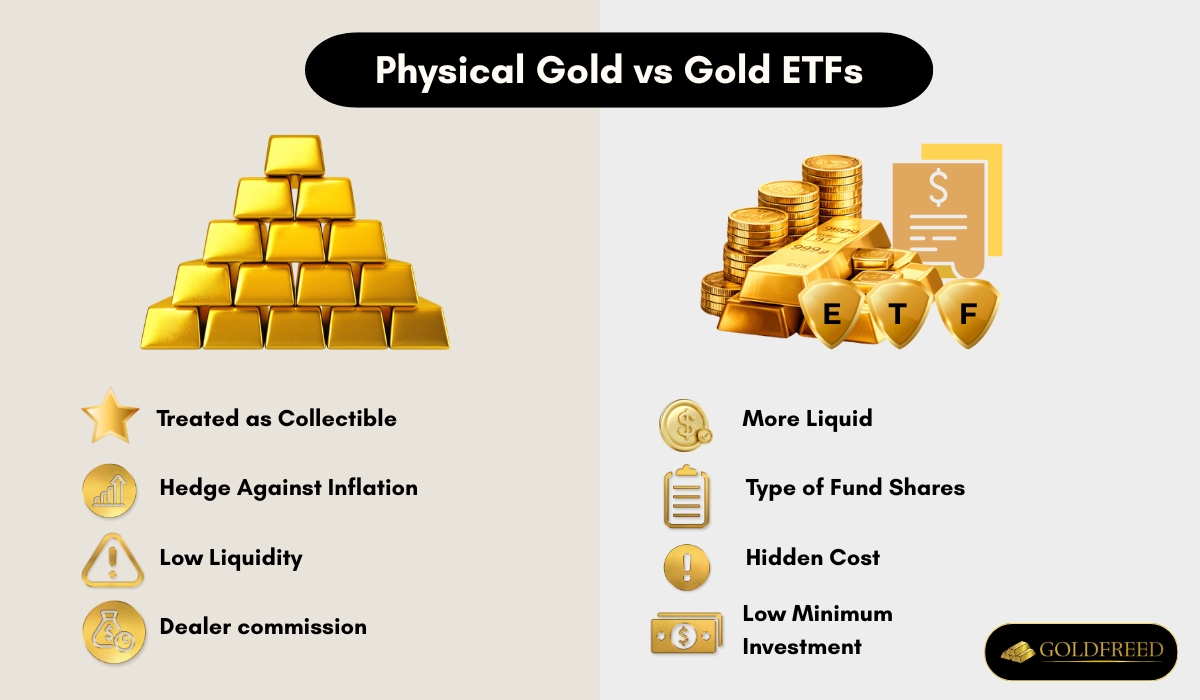
In contrast, physical gold entails direct purchase from a dealer. Secure storage-whether a safe at home or a rented vault-adds ongoing cost and effort, and the question of safe keeping is wholly yours. The metal is less liquid: you must find a buyer, verify quality, and arrange shipment, so transaction spreads are wider than those of ETF shares. Minimum investment is the weight of the smallest bar or coin you are willing to hold, normally higher than a single ETF share. Gold is used as a hedge against inflation, yet the same inflation protection is delivered by either form, the difference lies in convenience, cost structure, and personal preference.
Gold ETFs are an ideal medium for acquiring exposure to gold value motions and the leading tool for tactical trading, giving reduced price and portfolio fluidity through any additional share bought or sold immediately within a nondepository financial institution account. Yet the physical existence of a gold coin or bar gives a deep feel of safety and enduring, for gold is a tangible thing that lies outside the digital or financial structure, providing an unparalleled manner of money conservation. Although warehousing and coverage, the mental solace of immediate possession surpasses those difficulties.
What are the pros and cons of gold ETF vs physical gold investment?
The pros and cons of gold ETF vs physical gold investment are given in the table below.
| Gold ETFs | Physical Gold |
|---|---|
| Pros: | Pros: |
| - Provide portfolio diversification | - Tangible ownership gives psychological comfort |
| - Allow quicker trading in short-term investments | - No counterparty risk |
| - Offer liquidity | - Independence from financial systems |
| - Gold ETF shares can be sold instantlyduring market hours | - Assay certificate verifies purity of the gold |
| Cons: | Cons: |
| - Carry fund manager performance risk | - May require secure storage |
| - Involve brokerage fees | - May have storage fees |
| - May have management fees | - May require insurance costs |
| - May involve tracking error | - May have risk of theft |
| - May have fund mismanagement risk | - May require dealer commissions |
| - May be forced to sell at inopportune times | - May require intensive maintenance |
| - May have closure risk | - May have sales tax on the purchase- Insurance cost- Dealer premium |
Gold ETFs provide portfolio diversification without physical storage concerns and offer liquidity through quick trading that can be executed instantly during market hours. They allow much quicker trading in short-term investments than physical metal, but carry fund manager performance risk and involve brokerage fees plus annual management fees that chip away at returns over time. Tracking error and fund mismanagement add further ETF risks, while closure risk forces investors to sell at inopportune times.
Physical gold requires secure storage and insurance, leading to storage fees, insurance costs, and a dealer premium on purchase. It is subject to sales tax depending on location and incurs dealer commissions, premiums are more crucial for smaller investment quantities. The tangible metal also bears the risk of theft and requires an assay certificate to verify purity.
Trading prices for ETFs are usually lower than the major premiums I would pay over spot for physical coins or bars, so the cost advantage makes gold ETFs a useful element of my financial strategy. I value the capability to purchase and trade assets through my account, a convenience that eliminates the logistical issues associated with physical gold, such as arranging secure storage and insurance. Yet a digital stake cannot duplicate the feel of safety that comes from owning physical gold.
Thomas GoldfreburgInvestor at Goldfreed
Which option is better for you: gold ETF vs physical gold investment?
Physical gold has tax liabilities, and the IRS classifies it as a collectible, so any gain is taxed at a higher capital-gains rate. On top of that, physical gold has sales tax at purchase and ongoing insurance costs, you must pay to store and protect the bars or coins. A gold ETF avoids those frictional costs: there is no sales tax, no insurance bill, and no need for a safe-deposit box. The fund handles custody and the shares are taxed like a stock, usually at the lower long-term capital-gains rate when held longer than one year.
The best investment advice is to match the vehicle to your objective. If you want a low-maintenance, liquid position that you can trade through a brokerage account, a gold ETF is the cleaner choice, you capture the metal's price movement without the drag of insurance, storage, or special tax treatment. If you insist on holding tangible assets outside the financial system, accept the extra cost: budget for insurance, store the gold securely, and prepare for the higher tax rate when you sell. In most tax-efficient, cost-sensitive portfolios, the ETF is the better tool, physical gold is justified only when personal possession is a non-negotiable part of your strategy.
My choice moved toward gold ETFs after I rapidly faced the disadvantages of holding tangible bars. Premiums, the requirement for safe and insured holding, and illiquidity were major cons, whereas gold ETFs offer convenience and reduce economic friction. With the ETFs I can trade my assets easily, purchase stocks with clicks, and I immediately respond to industry trends because the price transparency reflects the gold market.
Thomas GoldfreburgInvestor at Goldfreed
ETF vs digital gold: Which is a better investment?
Digital gold vs gold ETF: digital gold does not offer any meaningful advantages vs gold ETF, and the only differentiator is the physical delivery option; however, gold ETF does not offer this option.
The comparison between ETF and digital gold as investment options is presented in the table below.
| Category | Gold ETFs | Digital Gold |
|---|---|---|
| Profitability | Both track the same benchmark-real gold value-so daily NAV moves almost in lock-step, neither adds extra upside, and the same gold price risk is tied to real gold value. | |
| Liquidity | Gold ETFs are regulated by SEBI and trade on recognised exchanges with live quotes, so you can exit within seconds at the market price. | Digital gold offers instant redemption to cash through the same app, but the counter-party is a single private entity, thus, ETFs win on depth of buyers and anonymous settlement. |
| Minimum investment | ETFs are sold in whole units that currently cost roughly one gram (0.0353 ounces). | Digital gold is bought for the value of 0.1 gram (0.00353 ounces), small savers therefore find digital gold more affordable. |
| Tax | Both follow identical capital-gains rules: three-year short-term added to income, long-term post-indexation at 20%. Neither enjoys a separate tax window, so the score is even. | |
| Risk | Gold ETFs are regulated by SEBI and have transparent structures, with physical gold stored in vaults and daily disclosure of holdings. | Digital gold depends on the issuer's promise, if the firm collapses, recovery is uncertain, making ETFs the safer choice. |
| Trading | ETFs can be lent, pledged or intra-day traded with limit orders. | Digital gold is usually a buy-and-hold balance inside an app, active investors therefore prefer the ETF route. |
| Summary | If you value safety, liquidity and exchange-traded flexibility, choose gold ETFs. | If you want micro-sums and instant mobile purchase, digital gold is convenient, provided you accept higher counter-party risk. |
I chose Gold Exchange-Traded Funds because buying gold through an ETF is similar to buying a regular stock. I do not have the metal physically , yet I could buy portions containing gold through my holding account and could trade at stock exchange during trading times with a couple of clicks. Buying and trading avoid hassles of physical verification, dealer negotiation and the requirement for storage. My first attempt started with physical gold, little bars and coins. Yet physical gold has limitations: accessibility is lower, safe storage requires a depository compartment whose yearly fixed costs and assorted expenses are considerable drawbacks for an existing shareholder. I experienced practical disadvantages as well: a house safe carries its own risks, and purchasing and trading requires finding a reliable vendor and paying premiums over the spot cost. When I wanted to exchange my funds back to cash rapidly, the ETF made it smooth.
Thomas GoldfreburgInvestor at Goldfreed
What are the pros and cons of ETF vs digital gold investment?
The pros and cons of ETF vs digital gold investment are presented in the table below.
| Aspect | Gold ETFs vs Digital Gold |
|---|---|
| Management Fees | Gold ETFs have small management fees charged by fund houses |
| Market Volatility | Gold ETFs subject to stock market volatility |
| Regulation | Gold ETFs are very well regulated by SEBI for investor safety |
| Taxation | Gold ETFs tax long-term capital gains tax with indexation |
Gold ETFs carry small management fees levied by fund houses, yet they are very well regulated by SEBI for investor safety. Because the units trade on stock exchanges, their prices fluctuate with market volatility, adding price risk beyond the underlying metal. Taxation follows equity rules: long-term capital gains tax with indexation applies after a three-year holding period, resulting in better post-tax outcomes for patient investors.
Digital gold, in contrast, imposes no fund-level charges, but the spectrum of providers is narrower and oversight lighter, so counter-party risk is higher. Liquidity is 24/7 on smartphone apps, yet conversion into physical bullion involves making and delivery fees that erode the advertised spread. Capital gains on digital gold are treated like debt instruments-indexation is not available-so high-bracket investors pay more tax than on ETFs.
Taken together, ETFs suit cost-conscious investors who value SEBI-mandated transparency and equity-style tax treatment, whereas digital gold fits those prioritising fractional, app-based convenience and instant purchase, provided they accept softer regulation and a less favourable tax structure.
Investing in gold ETFs removes the need for physical storage and safety worries, yet the investment company holds a yearly expense that can reduce returns. I find gold ETFs liquid and convenient, since I can purchase or sell units through my account. Still, ETF stocks comprise a paper claim on gold, so I do not maintain physical gold and must regard counterparty risk. Digital gold platforms eliminate the risk of physical storage and give a sense of instant ownership, so I can buy little exact quantities of gold and enjoy the simplicity of an online transfer with reduced trade expenses. However my ownership depends on the platform’s trustworthiness; if the organization were to fail, my claim on the gold could be at risk.
Thomas GoldfreburgInvestor at Goldfreed
Which option is better for you: ETF vs digital gold investment?
Digital gold is a good means to achieve exposure to gold if you value physical gold backing. Gold ETFs are also a good means to achieve exposure to gold, especially if you prefer regulated exchange-traded products and value low investment sizes.
The exchange-traded route lets you place an order on NSE or BSE during market hours, so units appear in your demat account the same way shares do, digital gold, bought through a payment app, is stored by the seller in a vaulted gram balance and gets converted to metal or cash at any hour. Because gold ETFs are listed on NSE and BSE, you can see a live price and exit with a sell order on BSE, paying only the usual securities transaction tax and capital-gains rules, digital gold normally carries a wider bid-ask spread and adds delivery or making-charge fees if you later ask for a coin. Both forms share the same tax fate: gains from gold investments held for less than three years are taxable per investor's income tax slab rates, while a three-year-plus holding attracts long-term gains at 20% with indexation, so your tenure decision weighs liquidity needs against the tax delta. If you value instant, low-cost exit and already use a broking account, an ETF is the cleaner fit, if you want the freedom to gift or redeem tiny quantities as jewellery and do not mind the issuer's storage promise, digital gold feels more flexible.
Digital gold platforms fitted my goal of creating systematic, small investments. Gold ETFs offered accessibility, they trade like shares, and were already within my present account. Because my financial style prioritizes convenience and cost-efficiency over tangible ownership, the choice between the two came down to digital gold versus ETFs. Digital platforms provided fungibility, while ETFs delivered the same market access without extra accounts.
Thomas GoldfreburgInvestor at Goldfreed
Is digital gold vs physical gold investment better?
Investing in gold through digital platforms, ETFs, gold futures or Sovereign Gold Bonds necessitates an investment account. Gold is treated as a collectible for tax purposes. Gold futures contracts are subject to a top federal tax rate of 26.8%. Sovereign gold bonds pay taxable interest, but capital gain is exempt. Capital gains tax is applied when selling the yellow metal.
I switched to digital gold programs because I could purchase portions of gold directly from my mobile with a low trade fixed cost. Holding digital gold gave me peace of mind and the model integrated into my total financial strategy, and the absence of storage concerns was liberating. Previously, I bought coins and bars, yet the whole ordeal felt cumbersome and illiquid. Procedure of selling physical gold required coordinating with sellers, while meetings with vendors were stressful. Digital gold operation gave me a different experience: fast liquidity. Although physical gold experienced an actual long-term store of value, the practical cons led me to prefer the digital model.
Thomas GoldfreburgInvestor at Goldfreed
What are the pros and cons of digital gold vs physical gold investment?
Digital gold has lower upfront and transaction costs, but you pay another transaction cost when it is time to sell. Secure off-site storage holds your investment, yet you pay ongoing storage fees, and secure off-site storage has ongoing storage costs.
The pros and cons of digital gold vs physical gold investment are presented in the table below.
| Digital Gold Investment | Physical Gold Investment | |
|---|---|---|
| Pros | Liquidity; You can buy as little as $5 in gold; Sovereign gold bonds are redeemable tax-free on maturity SGBs can be purchased at authorized banks, post offices, brokerage firms, and online platforms; Investors can invest in SGBs | Physical gold offers tangible alternative and direct exposure; Physical gold carries BIS hallmarking that guarantees purity and fineness of gold; Physical gold can be used as collateral for loans; Physical gold can be gifted or inherited; Physical gold could serve as a hedge against extreme market conditions |
| Cons | Capital gains taxes (at a higher "collectible" tax rate) | Physical gold may involve dealer commissions, making charges, GST, and storage costs; Physical gold carries capital gains tax when selling; Physical gold may have transportation costs; Physical gold may be subject to theft risks; Physical gold purchases require commitment to buying specific coin or bar size; Physical gold come with storage and insurance; Physical gold purchases involve dealer commissions |
Digital gold and physical gold each carry distinct trade-offs. The electronic form offers high liquidity overall, at many platforms you can buy as little as $5 in gold and exit by tapping a smartphone. Carrying costs are negligible because there is no dealer commission, no making charge, no home vault, no insurance, and no GST on storage. In contrast, physical gold purchases involve dealer commissions, charges, and usually pull in GST on jewelry. The metal is stored at home or in safe deposit boxes, and that convenience pushes many buyers into annual plans that include both storage and insurance fees. Transportation costs also surface whenever a bar changes hands.
Other exposures diverge. A sovereign gold bond is issued by Reserve Bank of India on behalf of the Indian Government, interest accrues at 2.5% and maturity proceeds are redeemable tax-free, whereas capital gains tax is charged when selling the yellow metal if the holder instead bought coins or bars-sometimes at the higher collectible tax rate. Investors prize physical gold because it serves as collateral to obtain loans from banks, can be gifted or inherited, and acts as a hedge against extreme market conditions. Yet it will disappear, physical gold faces theft risks at home and even bank lockers experience break-ins. BIS hallmarking guarantees purity of gold when it is bought, but every storage box still holds the practical risk of loss.
Versatility also differs in size. Digital platforms or SGB units allow any fraction of a gram to be bought or sold, while physical gold purchases require commitment to buying a specific coin or bar size or piece of jewelry. Transaction convenience rules again: SGBs are made available for purchase at online platforms, brokerage firms, authorized banks, and post offices, and investors can invest in SGBs in minutes. The choice of investment depends on the investor, yet for those who value a tangible alternative and direct exposure the ancient yellow metal remains attractive. Others, however, skip the logistical burden, for them the paper or pixel form, freed from vaults and taxes on maturity, is often preferred.
Digital investments cannot replicate the feel of safety that tangible gold gives. Direct possession is independent of the digital system, giving unmediated ownership and a hedge against systemic risks. Investing in digital gold eliminates logistical concerns, yet owning tangible gold involves safe storage and insurance expenses. Less transaction prices make the ETF a cost-effective method, and overall returns are reasonable.
Which option is better for you: investing in digital vs physical gold?
Which option is better for you-digital or physical gold-depends on why you are buying and how you intend to use the metal. Physical gold carries 3% GST and the added cost of locker rent, yet it is gifted or kept in a secure vault for decades with no counter-party risk. Digital products avoid the tax on every gram and let you buy in smaller denominations. Sovereign gold bonds, sold at authorized banks, post offices, brokerage firms and online platforms, add a government-paid interest coupon on top of capital gains, making them attractive if you can hold for the full eight-year cycle.
My personal journey into gold investment started with tangible gold. Gold holding gave me immediate possession, I bought a few gold coins from a trusted seller. Keeping the metal money supplied a deep feel of safety, yet there were some cons: I often paid above spot price due to dealer premiums, I had to set up a safe storage at home, the selling was burdensome, because I had to carry the coins and could trade whole metal coins, not a part. After several years, I switched to digital gold through a sovereign gold program. Buying portions of a gram allowed exact portfolio allocation. Buying in fractions of a gram allowed portfolio allocation and greater flexibility. I could trade a part of my holdings easily through my broker, even after the lock-in term, the funds were transferred straight into my finance balance. The whole operation was smooth, paperless, and I could trace the price every day.
Thomas GoldfreburgInvestor at Goldfreed