Gold and oil have long served as counterweights in commodity portfolios, yet their investment profiles diverge sharply. One is a dense, glittering metal hoarded since antiquity; the other a viscous fluid that literally keeps the modern world in motion. This article weighs their respective merits, tracing how each asset hedges inflation, responds to geopolitical tremors, and fits within a balanced allocation.
Expert behind this article

Thomas Goldfreburg
Thomas Goldfreburg is a gold investment advisor, author and founder of Goldfreed. Thomas's expertise is built on an academic foundation of a Bachelor of Science in Economics from Stanford University and complemented by market experience. Thomas specializes in gold IRA, ETF, 401k, and physical gold investments.
Is gold or oil a better investment?
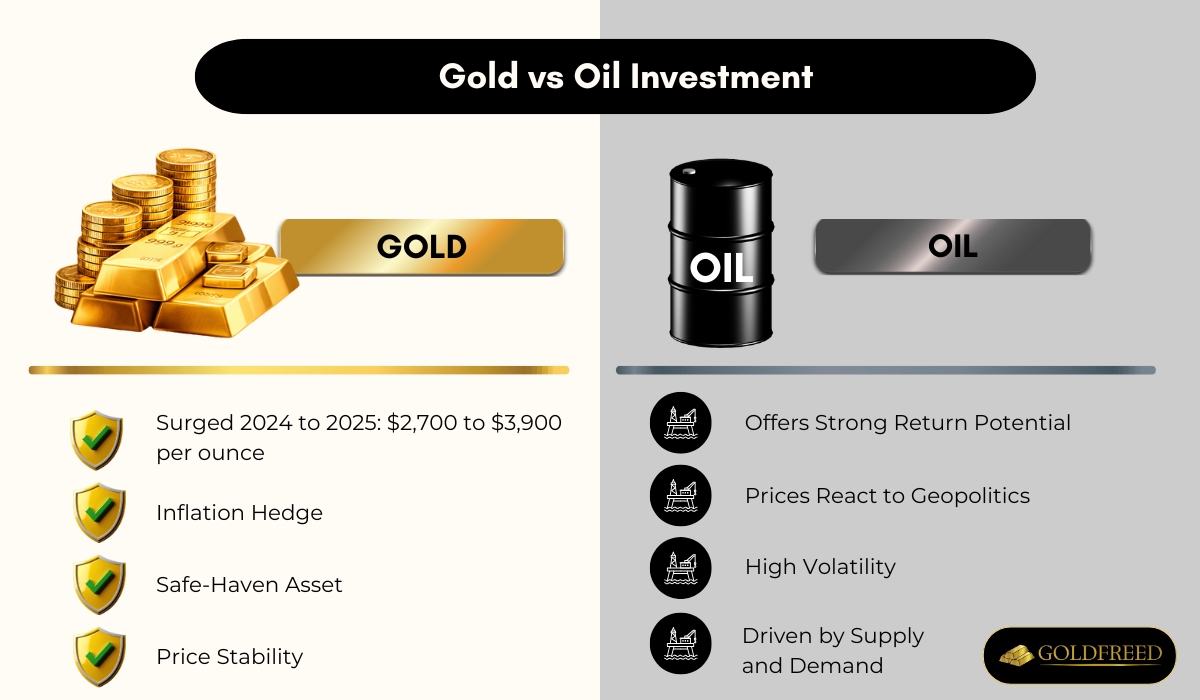
The comparison between gold and oil as a better investment is given in the table below.
| Investment | Information |
|---|---|
| Oil | Oil is among the most important investment assets globally. Oil generally offers stronger return potential. Oil can hold value. Oil can provide stability. Performance of U.S. crude oil relative to gold has been an effective indicator for the stock market. Oil prices can change drastically based on market conditions and world events. |
| Gold | Gold price surpassed $2,700 per ounce in October 2024. Gold price is $3,900 per ounce in October 2025. Gold prices jumped in the 1970s due to US government spending and reduced central bank credibility. UK inflation supports continued demand for gold as an inflation hedge. Gold has benefited from concerns about the path of US debt and deficits. |
Oil is among the most important investment assets globally, and Kelly Ann Winget explains oil generally offers stronger return potential. Oil prices change drastically based on market conditions and world events, yet oil provides stability and holds value, making it appealing for investors willing to tolerate volatility.
Gold has benefited from concerns about the path of U.S. debt and deficits, and UK inflation supports continued demand for gold as an inflation hedge. Gold price is $3,900 per ounce in October 2025, having surpassed $2,700 per ounce in October 2024. SentimenTrader notes that the performance of U.S. crude oil relative to gold has been an effective indicator for the stock market, suggesting that investors often choose between these two assets based on economic conditions and risk tolerance.
I consider my precious metal properties a foundational, protective part of my portfolio, value gets appreciated steadily and price does not swing dramatically. I invested in petroleum assets through an energy economy ETF, but the venture required constant attention to the worldwide situation. The price of my petroleum asset was further unstable, reacting sharply to changes in global demand, geopolitical events, and output data. Returns from the steady metal were modest, whileI had significant profits and I faced high losses from the volatile oil.
Thomas GoldfreburgInvestor at Goldfreed
Is gold more profitable than oil in long term?
Is gold more profitable than oil in the long term? History answers with a conditional no. Data show that when the gold-oil ratio has exceeded 30:1, crude returned 32 % on average over the next twelve months while gold returned 4 %. Kelly Ann Winget explains that oil generally offers stronger return potential, and Jay Young adds that timing affects returns from the two commodities.
Yet gold is a long-term store of value. It shines brightest during periods of high inflation and has outperformed most asset classes so far in the market sell-off. Gold returned 18 % on average during these periods and increased 360% from 1990 to 2020, outperforming the S&P 500 from 2000 to the mid-2020s.
The verdict is period-sensitive. Oil generates income through specific investment vehicles and its price pushes into the $250-$300 range in the long term, but gold continues its march upward when the world is in turmoil.
Long-term holding of oil-related resources demonstrated unstable and nerve-racking swings, while precious metal has been the more lucrative asset. Gold provides a sure store of value, has steadily appreciated, and maintains buying power with only minimal involvement. In contrast, petroleum ventures are always accompanied by serious downswings linked to geopolitical happenings and shifts in worldwide energy policy, the few profits I captured came from well-timed trades during supply shocks that demanded continuous observation.
Thomas GoldfreburgInvestor at Goldfreed
Which is more volatile: gold or oil?
Oil is historically more volatile than gold. Crude oil generally exhibits high volatility, especially in response to geopolitical events and changes in global supply and demand. Oil price tends to be more volatile, Mickey Fulp explains that oil price tends to be more volatile. Oil is one of the more volatile commodities and will continue to be one of the more volatile commodities. Oil prices change drastically based on world events and market conditions. Oil is susceptible to economic and political fluctuations. Oil price volatility exploded in 2014. Oil price volatility has a significantly positive impact on gold prices. Negative information shock in the oil market has a larger impact on volatility of gold return than positive shock. In the short run, oil volatility caused a reduction in gold prices.
Gold is the least volatile commodity compared to other variables. Gold's annualized volatility over the last 30 years is 15.44 %. Gold has historically provided lower volatility relative to many other commodities. Gold price movements are often less abrupt compared to crude oil. Gold prices are volatile due to changes in supply and demand, global economic conditions, and monetary policies, yet gold remains less volatile than oil. Gold-to-oil ratio provides insights into stock market volatility and potential economic crises.
Which is more risky to invest in: gold or oil?
Crude oil prices are highly influenced by geopolitical tensions and economic indicators. Kelly Ann Winget explains oil generally offers stronger return potential, yet this reward travels with higher volatility.
Gold is a safe haven. Its value tends to rise when confidence in currencies or equities falls, so daily swings are narrower and direction is more predictable. Because gold is a safe haven, investors regard it as insurance rather than speculation, lowering the probability of sudden, large losses relative to oil.
Petroleum holds top level of peril attributable to direct links to worldwide occurrences, geopolitical hostilities and sudden changes in manufacture allocations provoked spectacular value movements, so value of my venture swung wildly and fell significantly within a single trading month. The gold part of my portfolio is considered as a stabilizing element, it provides protection against rising prices and market disruption. Gold cost does not weaken, so gold part of my holdings stayed firm during periods when my oil investments worsened.
Thomas GoldfreburgInvestor at Goldfreed
Which is easier to invest in: gold or oil?
Adam Ferrari notes it is easier to gain direct exposure to oil than other commodities. Oil is accessed through futures contracts, and crude oil trading is one of the most actively traded commodities in the world. Investors can hold gold through direct ownership of the physical commodity, a form of access unavailable to crude oil buyers. Although gold is also accessible through futures contracts, those contracts require investors to deposit an initial margin, a hurdle not present when one simply buys bullion.
Gold is a simple resource, and the operation is available through easy deals. I can place in gold-backed assets through a securities firm account, buy active precious metal, or buy metal money from respected vendors. These measuring devices track the cost of precious metal, so gold contributes to my portfolio. Investing directly in oil is more complicated: I cannot purchase barrels of petroleum, and logistical operations are huge. My particular approaches are parts of petroleum companies, but stocks of petroleum companies reflect corporate performance, which fluctuate independently of product cost. My approaches are commodities futures contracts, but such agreements bring significant risk and need advanced comprehension of industry.
Thomas GoldfreburgInvestor at Goldfreed
Which is better for beginners: investing in gold or oil?
Gold investing makes the most sense if your main goal is to get stability and protection against economic turmoil, and Adam Ferrari notes gold investing is easier to gain direct exposure to than other commodities.
Beginners usually find gold as the gentler teacher. Gold is one of the most actively traded assets in the world, yet its daily swings are smaller than crude oil's price, gold prices rise and fall in sync with the cost of living, so surprises are rare and the learning curve is smooth. A first-time buyer can buy a gold ETF whose price is linked to the price of gold and hold it without fear of contango, storage, or margin calls.
Oil, by contrast, is an economic barometer that changes drastically based on world events. Crude oil is among the most actively traded assets in the world, and Kelly Ann Winget explains oil offers stronger return potential, but that extra reward sits beside abrupt gaps that erase weeks of progress overnight. CFDs allow you to trade oil without owning a single barrel of oil, yet the leverage they offer multiplies both gain and loss, novices who misunderstand a single geopolitical headline will be stopped out before lunch. Therefore, beginners start with gold, observe how macro news slowly filters into the quoted price, and only after they have survived a full market cycle look at venturing into oil.
For beginners, crude oil investment is overwhelming, whereas the precious metal industry is simpler to understand. I find gold a desirable beginning because I can buy tangible precious metal: bars or ducats, or I invest through a precious metal exchange traded fund. Precious metal gives a sense of safety: it serves as a steady store of worth during economic uncertainty, and its long-term worth is not bound to the performance of a single company or government. Petroleum fundamentals are heavily influenced by geostrategies and industrial production, so petroleum cost is uncertain and can provide substantial yields. Yet my first financial priority is ease and controlled risk handling, therefore I prefer a resource that lets me discover the market without being exposed to intense cost swings.
Thomas GoldfreburgInvestor at Goldfreed
What are the pros and cons of investing in gold and oil?
Investing in gold provides a hedge against inflation and during periods of stress in stock and bond markets, providing stability, diversifies portfolio, offering tangible asset ownership, benefiting from global demand, and serving as a safe-haven asset during economic uncertainty. Though gold does not generate income or dividends, and physical gold includes extra expenses like dealer commissions, storage, and insurance, gold investing also magnifies losses with smaller price movements. Oil provides stability and inflation protection, and Kelly Ann Winget says oil generally offers stronger return potential, however, oil prices change drastically based on world events.
Gold produces no yield, yet it served as a trustworthy shop of worth that moved inversely to the stock market, letting me maintain my principal during downswings. Still, its cost can drift sideways for long periods, while the expenses related with safe storage and coverage eat away my possible returns. Oil company shares afforded exposure to profits and provided a cash flow that precious metal lacks, while the high liquidity of the oil industry permitted simpler access and exit. I felt intense unpredictability because costs could drop due to factors beyond my control: world-wide economic slowdowns, changes in energy policy, and logistical restrictions, even though geopolitical events also established cost rallies.
Thomas GoldfreburgInvestor at Goldfreed
What are some tips for gold and oil investment?
Tips for gold and oil investment are provided below.
- Buy commodities like gold and oil to hedge against inflation.
- Buy bullion coins and bars with the lowest dealer markup.
- Perform advanced technical analysis combined with leveraged products like derivatives for experienced gold investors.
- Study historical price movements to strategically time entries and exits in gold markets.
- Maintain a 5-15% allocation in gold for portfolio diversification (regard limiting gold exposure to less than 3% of one's overall portfolio according to financial advisors).
- Invest in commodities through mutual funds and ETFs for diversified exposure (regard gold ETFs as a low-cost, tax-efficient way to invest in gold).
- Consider investing in mining stocks or funds as part of silver and gold investment strategies.
- Use gold as an insurance policy against inflation and economic uncertainty.
- Compare premiums from multiple sellers when buying precious metals.
- Tips propose blending active mutual funds with select mining stocks and ETFs for upgraded risk-adjusted outcomes.
Start with physical ingot or small bars. Possession eliminates risk and provides a tangible sense of security. Store the metal in a qualified vault or a depository secure bank boxes, and account for the premium over the point cost while checking the .9999 purity. Diversify your portfolio by investing in different assets. Gold ETFs like SPDR Gold Shares and iShares Gold Trust give low-cost, liquid, tax-efficient exposure that can be bought and sold quickly through an ordinary brokerage account, investors can also buy bullion or coins from a bank or other dealer to hold the metal outright, provided they factor in storage and dealers' premiums. Compare before you commit. Whether you choose bullion coins and bars, ETFs, or mining stocks and funds, check mark-ups, management fees, and storage and shipping costs from multiple sellers, bullion coins and bars that track daily spot prices normally carry the lowest dealer markup. For oil, convenience and diversification come through an oil ETF or a broader commodity mutual fund, each holding futures rather than barrels, direct players can drill deeper via individual oil stocks or the futures market itself. Think insurance, not jackpot. Gold and oil can soften equity shocks and beat inflation every day of the week, but they do not compound like corporations, so treat them as stabilising satellites, not portfolio cores.
For oil, I researched oil risk through exchange-traded finance that tracks oil futures, this way provided a view to the product's cost trends. I observed OPEC choices and geopolitical events, since these components induce substantial cost volatility and this field possesses fundamental uncertainty. I allocated a part of my portfolio to this field, having identified its liquidity examined to different kinds.
Thomas GoldfreburgInvestor at Goldfreed