Gold and palladium each bring unique strengths to an investment portfolio: gold stabilizes the portfolio whereas palladium provides growth potential linked to industrial demand. Gold is primarily used for jewelry and as a financial asset, while palladium serves mostly as an industrial metal, resulting in palladium having higher volatility. Gold has lower price volatility versus palladium, having lower risk whereas palladium has higher risk, and gold has broader market size versus palladium, assuring gold has higher liquidity versus palladium. Gold is a proven hedge against inflation, yet palladium contributes to diversified investment risk and can be invested through ETFs or mining stocks alongside gold.
Which is a better investment: gold vs palladium?
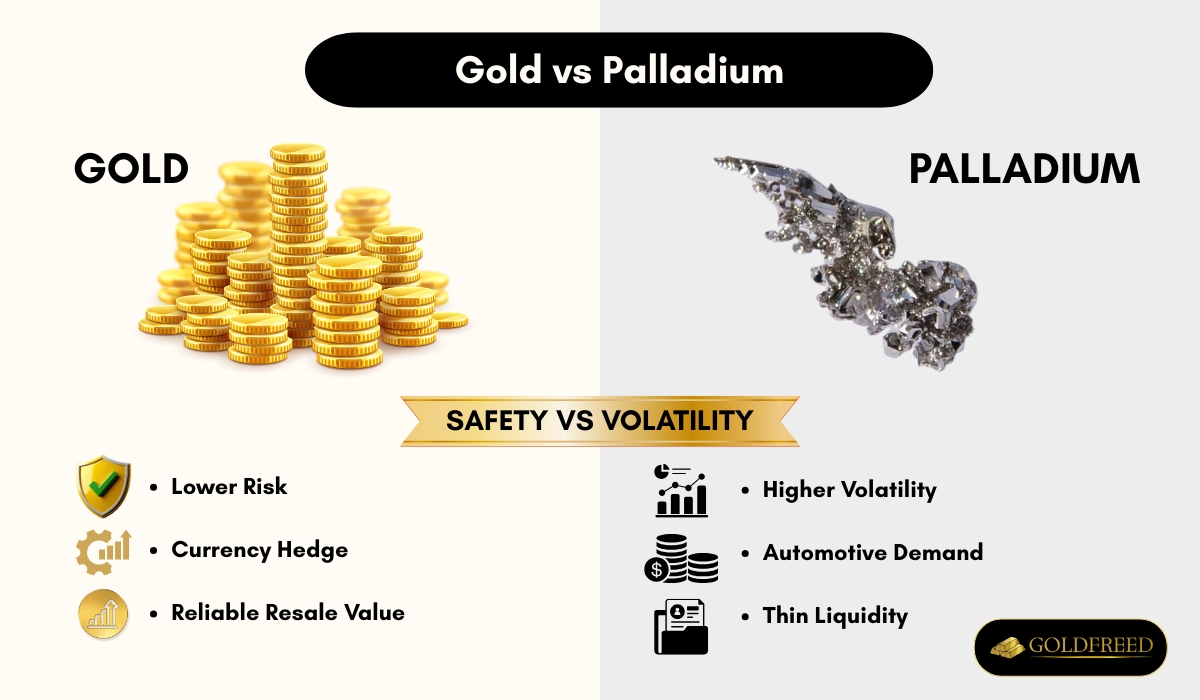
Gold is a preferable option for lower risk tolerance, the metal has historically been the leading investment metal, and its century-deep global market provides even modest portfolios with liquidity and price transparency. Palladium, in contrast, is chemically similar to platinum but far more volatile, because increasing demand for palladium in the automotive industry causes a single technology shift to erase or double usage.
Exposure to palladium therefore appeals to investors who can tolerate sharp swings in exchange for a growth story tied to tightening emissions rules; gold offers a steadier, defensively aligned store of value. If capital preservation is preferable, gold fits, if tactical speculation on industrial scarcity excites, palladium deserves a satellite allocation.
Palladium's cost was to a greater extent unstable, driven by industrial demand and logistics restrictions, whereas my gold assets endured a slow, stable rise. I watched gold shifts as a trustworthy store of value, and the physical tangibility of the asset gave a feel of safety. The rise fits absolutely with my financial plan, making gold a foundational part of my portfolio.
Thomas GoldfreburgInvestor at Goldfreed
Which is safer as a long-term investment: palladium vs gold?
Gold remains a time-tested safe haven, and central banks hold it as the only precious metal in their reserves, so it is safer than palladium as a long-term investment. Gold has shown the most consistent long-term price appreciation among precious metals, while palladium fell during the worst stock market crashes. Therefore, gold is more stable in a crisis, and its market behaves with lower volatility, making it the safer choice for investors who want to diversify and protect purchasing power.
Gold combined its function as my foundational low-risk investment and as a dependable mainstay in my portfolio. I have never experienced fear of unexpected declines with gold investment, instead, I discovered huge relief in its steadiness during times of market volatility. My attempt into palladium was uneasy: I observed its price moving sharply, dependent on automotive-market forecast and production, and it felt more like a risky resource than a safe store of value. The cost of palladium did rise, yet its foreseeable long-term operation never backed my opinion in its security. Consequently, gold is safer for a long-term investment.
Thomas GoldfreburgInvestor at Goldfreed
Which is a better hedge against inflation: palladium or gold investment?
Gold has traditionally been regarded as a good hedge against inflation over the long term, rising as the purchasing power of the dollar declines. Gold is widely viewed as an inflation hedge because it tends to maintain or increase in value when fiat currencies weaken, and liberal central-bank policies like quantitative easing have repeatedly driven gold to great highs. Private investors value gold as a hedge against inflation and currency devaluation, while Treasury Inflation-Protected Securities provide built-in inflation protection for bond holders. Gold delivers a proven hedge against economic uncertainty, whereas palladium lacks the centuries-long record of preserving purchasing power.
Gold provides diversification and inflation protection within a well-structured portfolio, yet palladium’s price is driven principally by industrial automotive demand, not monetary demand, so it tracks inflation less reliably than gold. Consequently, gold acts as a hedge against inflation and currency fluctuations, making it the superior choice for investors seeking protection from rising prices.
Gold kept its value when rising prices was a main worry, and the steady was comforting. The cost of gold was appreciated, while its trends were slow. Palladium, instead, endured a crisp decrease attributable to a downswing in car manufacture, because its industrial uses are especially in the automotive field. Its price is heavily impacted by stock and activity mechanics within particular markets, and these mechanics are not invariably at once linked with inflation charges. Hence, gold acted as the better hedge, whereas palladium sometimes felt further like a protective cornerstone than an offensive windbreak.
Which price is more volatile: for palladium or gold?
Palladium price is more volatile than gold price because of a less liquid market. Palladium exhibits higher volatility due to industrial demand and supply constraints. Gold generally exhibits lower volatility, gold prices are much more stable compared to most other assets, particularly during periods of crisis.
Palladium's cost is far more sensitive to the availability of stock and to the present status of the automotive business, so it can experience intense value movements. A sole interruption in mine production or a major change in automotive manufacture allocations can cause sharp falls within days. In contrast, gold's price is profoundly set in its function as a safe-haven during economic uncertainty and as a monetary resource, and its deeper, more varied requirement structure gives a buffer against crisp value movements. Consequently, gold's cost alterations are mostly evaluated, and it is resistant to changes, whereas palladium does not have such a buffer.
Does gold offer better returns than palladium?
In most recent five-year windows, gold drove the majority of returns, posting modest gains of about 3% in 2022 while palladium fluctuated from triple-digit surges to 30% pull-backs within twelve months. The wider band is explained by a market one-tenth the size of gold: a single automotive policy or mine closure drives palladium quotes violently, whereas gold's eight-trillion-dollar liquidity dampens shocks. Because industrial production output dominates palladium demand, prices rise quickly when converters are needed and fall just as fast when thrifting or battery cars advance. Gold, valued for its monetary function, moves on real yields, currency swings and systemic fear, giving it a smoother, albeit slower, climb. Over the past decade the average annualised return is roughly equal, yet the path differs: palladium doubled twice, but gold never printed a calendar loss greater than 5%. Investors with lower tolerance for risk therefore find gold preferable, trading a little upside for visibly smaller draw-downs and deeper resale markets at every hour of the day.
Gold's performance gave a feel of safety that was its own type of return, the yields gave a reassuring buffer against the instability of additional investments and were reliable. I saw its value appreciate steadily, like a gradual, intentional ascent. My experience with palladium was different: the returns were volatile, and the value of my metal assets was more changeable. Although the price of my palladium assets had an abrupt rise driven by automotive market demand, the whole journey was nervous, and the price of my metal holdings witnessed significant corrections.
Thomas GoldfreburgInvestor at Goldfreed
Which metal is easier to purchase: gold or palladium?
Because gold is traded worldwide, it is widely available as coins, bars, and jewelry, making physical gold easy to buy and sell. Gold is by far the most actively traded precious metal, so it attracts the highest daily demand and deepest pool of dealers, guaranteeing that any investor, large or small, can close a transaction quickly.
Palladium, in contrast, is mined in only a few places: supply is concentrated in Russia and South Africa, and the total market is worth slightly over sixteen billion dollars. Such limited output and geographic connection make palladium relatively rare in retail form, the selection of coins and small bars is limited, and certain products are harder to offload quickly at fair prices. As a result, gold is easier to purchase than palladium, and it is also more liquid: bids are always available, whereas palladium investors face delays or lower bids when they wish to sell.
Which is taxed more: gold or palladium investments?
Physical gold is classified as a collectible, after one year any gain is taxed at the investor's marginal rate up to a maximum of 28%, the same rate that applies to palladium. Palladium and platinum do not have the same tax-exempt status as gold after 22 years of ownership, so holdings in palladium remain subject to capital gains tax regardless of holding period. In practice both metals face the same 28% ceiling on long-term gains, yet short-term positions in either are taxed as ordinary income. The IRS treats ETFs backed by physical precious metals as collectibles, so shares tied to gold, silver, platinum or palladium ETF holdings are also subject to the 28% maximum federal income tax rate.
What are the pros and cons of investing in gold or palladium?
Investors weigh several pros and cons before choosing gold or palladium. Gold is a precious metal with global recognition, portability and high liquidity, it has no counterparty risk and can be stored in a bank safe-deposit box. Bars and coins are tangible, unleveraged assets that hold inherent value and provide direct exposure. Gold provides portfolio diversification, adds balance and security, and offers a safe haven during economic uncertainty or downturns. Limited supply creates a favorable supply-demand dynamic that leads to price appreciation with long-term wealth preservation. Yet physical gold investment comes with storage and insurance costs, does not generate passive income, and carries an ongoing risk of theft. Capital-gains tax and behavioural risk affect net returns.
Palladium shares the storage-and-insurance cost burden and, like gold, produces no income stream. Its price is driven mainly by the automotive industry, which drives demand for palladium, but the move to electric vehicles will diminish industrial demand for palladium, raising long-term risk. This dependency on a single sector makes palladium more volatile, investors willing to tolerate more volatility find upside in periods of supply shortage, yet limited supply creates a favorable supply-demand dynamic that leads to rapid price appreciation. Overall, gold remains a reliable choice for wealth preservation and liquidity, while palladium offers higher growth potential at the cost of greater headline risk and uncertain future demand.
Gold's long history gave me mental solace, I saw it as a safe-haven asset, and its cost remains steady, beneficial for asset protection. Yet precious metal rarely delivers spectacular cost appreciation, as well as expenses for secure storage and insurance can eat away total proceeds. I branch out into palladium, captivated by its developed technologies: palladium's industrial uses are in the automotive field for catalytic converters. Palladium's price is tied to industrial requirement and supply restrictions, creating periods of spectacular cost trend and prospect for superior income. However, my palladium holding endured abrupt cost movements, sharp fluctuations made them a risky part of my portfolio.
Thomas GoldfreburgInvestor at Goldfreed
What are some tips for investing in gold and palladium?
American Gold Eagles offer the best liquidity for beginners, and dollar-cost averaging helps smooth out price volatility over time. Proper storage planning is crucial before your first purchase, which protects your investment portfolio in precious metals.
Tips for investing in gold and palladium are provided below.
- Mutual funds and ETFs that invest in securities of companies involved in the production of gold and other precious metals
- Palladium's rarity and high trading premiums over gold are key considerations
- Investing in palladium futures, a derivative instrument tied directly to the price of the actual metal
- Investing in coins and bars are the most direct way to hold precious metals
- Beginners should focus on gold investment to diversity portfolio
- Make regular monthly or quarterly purchases rather than attempting to time the market
The best way to invest in precious metals is to purchase ETFs, because ETFs allow investment in gold and platinum while remaining convenient and liquid. For those who believe physical property is principal for asset preservation strategies, investors can invest in bullion bars or coins, bars are the most direct way to hold precious metals, and physical bullion includes bars, coins and vaulted storage. Gold bars are 99.5%-99.99% pure, palladium bullion bars are 99.95% pure, and total cost equals spot price plus premium, where premium % = (purchase price - spot price). Palladium futures are a derivative instrument tied directly to the price of the actual metal, yet the palladium market is rather illiquid, has lower trading volumes than platinum, and trades at a massive premium to silver, therefore investors allocate only a low amount for short-term strategy that they can afford to lose and make regular purchases monthly or quarterly instead of trying to time the market.
I allocated a part of my asset to a respected precious metal ETF, this got rid of worries over storage and gave liquidity. I devoted a minored risky part of my portfolio to gold, because I view gold as a long term store of value and a protection against systemic danger. Furthermore, I acknowledged its volatility, so I realized that buying during market drops helped me to get an average price over time. Besides, I discovered placing strict stop loss levels and profit-taking targets is critical to managing the underlying risk. My research focused heavily on the development of uncommon fields and the automotive field, because these components at once affect metal's demand and I recognized its industrial dependence.
Thomas GoldfreburgInvestor at Goldfreed
Expert behind this article

Thomas Goldfreburg
Thomas Goldfreburg is a gold investment advisor, author and founder of Goldfreed. Thomas's expertise is built on an academic foundation of a Bachelor of Science in Economics from Stanford University and complemented by market experience. Thomas specializes in gold IRA, ETF, 401k, and physical gold investments.