Investors who compare rhodium with gold face two metals that sit at opposite ends of the rarity and volatility spectrum. Rhodium is 100 times rarer than gold; annual output totals only about 30 tons and comes solely as a by-product of mines concentrated in South Africa and Russia, while gold is mined commercially on every continent. This scarcity turns rhodium into the world's most expensive metal, yet its thin, inelastic supply also exposes prices to dramatic swings whenever automotive demand for catalytic converters shifts. Gold, by contrast, has long served as a safe-haven store of value that tends to rise when economies contract, offering steadier, lower-beta protection for portfolios.
Which is a better investment: rhodium vs gold?
I allocated a little part of my asset to rhodium because the rhodium parameter outperformed gold, and I noticed the rhodium price rose. Yet settling my rhodium involved steeper trade expenses, and the market was unstable. Gold served as a trustworthy mainstay, I saw it kept value, being a stable store of value. Although gold rarely gave a spectacular increase and its price rose slowly, the process was straightforward, and I could easily trade my gold to a local seller. Therefore, for most holders, gold remains the better choice.
Thomas GoldfreburgInvestor at Goldfreed
Which is safer as a long-term investment: rhodium vs gold?
Gold is a less volatile and more stable investment option, whereas rhodium can experience sudden and substantial price increases and decreases. Although rhodium is rarer and sometimes more expensive per ounce, gold and rhodium prices tend to fluctuate over time.
Gold is a safe bet for long term investments and the most stable choice for wealth preservation. Because gold is believed to be a safe haven investment, it carries lower risk than rhodium, lesser known gold. Over decades, gold has shown consistent long term price appreciation while maintaining deep liquidity, so holders can sell quickly at transparent prices.
Rhodium, by contrast, trades in a tiny market with unpredictable swings, during shortages its price triples, then halves within months. Without established futures or large bullion dealers, investors wait weeks to locate buyers and accept considerable discounts. Thus, for holders whose horizon is measured in years rather than days, gold's stability and liquidity make it the safer repository of value.
Gold is renowned for true long-term security, its value reinforces its standing as a foundation for long-term rich conservation. I discover the steadiness of gold to be the best, its worth offered security during economic uncertainty. I have never experienced difficulties in trading a part of my stock holdings, the fungibility of gold is extraordinary. Rhodium market is prone to abrupt corrections, so my attempt to invest in rhodium was a risky endeavor. I noted the price of rhodium rose to new highs, and I learned that this volatility is a double-edged sword. Rhodium market is heavily affected by industrial demand, so the possibility for spectacular profits was tempting, yet the investment remains precarious.
Thomas GoldfreburgInvestor at Goldfreed
Which price is more volatile: for rhodium or gold?
Rhodium price is more volatile than gold. Rhodium prices are highly volatile because demand is heavily concentrated in the automotive sector, while gold is deemed a haven with stable pricing.
Does gold offer better returns than rhodium?
Historical data show that rhodium, mined as a by-product of platinum and scarcer than gold, has at times surged far beyond gold's price, so a holder who timed entry and exit precisely collected larger percentage gains. Such spikes stem from thin supply and sudden industrial demand, yet the same thinness means prices plummet just as quickly. Gold, softer and used primarily for jewelry, experiences milder swings and fell less than platinum during recent downturns, so its lower volatility protects capital when sentiment shifts.
Portfolio managers therefore see rhodium as a candidate for small, speculative allocations, while gold acts as a steadier anchor. In absolute dollars, gold rarely matches rhodium's steepest peaks, but its liquidity, deeper markets, and gentle declines let nervous investors compound modest, reliable progress. Consequently, gold does not promise the highest headline return, yet it can deliver superior risk-adjusted performance for those who value preservation of principal.
The percentage increase on my rhodium investment was steeper, yet fast appreciation surpassed any returns I had seen from gold only during short bursts. I observed times of fast gains of metal, but its cost was more unstable and could decline sharply based on industrial consumption. Rhodium volatility made me appreciate gold more. The returns aligned with long-term rising prices, the worth of my assets appreciated steadily, and the fact of having a physical resource gave stability. The liquidity was excellent, I could find a buyer, and the main advantage I experienced was the tranquility it assured.
Thomas GoldfreburgInvestor at Goldfreed
Which has higher demand: rhodium vs gold?
Gold enjoys a more stable demand than rhodium because it has a diverse range of applications and a historical status as a store of value. About 80% of rhodium demand comes from the automotive sector, where manufacturers use it to reduce nitrogen oxide emissions, so its demand is sharply industrial and far less balanced. Jewelry industry demand for rhodium is growing, yet this segment remains small compared with the dominant automotive need. The high price tag results from extreme scarcity and intense but narrow demand, whereas gold production of roughly 2,500-3,000 tonnes per year ensures broader, steadier consumption across jewelry, technology, and investment sectors.
Which is taxed more: gold or rhodium investments?
The IRS classifies gold as a collectible, so long-term capital gains on physical gold are equal to an investor's marginal tax rate up to a maximum of 28%, short-term gains are taxed as ordinary income. Gold ETFs are treated as collectibles for tax purposes and face the same 28% ceiling. Stocks, bonds and other investments generally have a 20% top rate on profits, so investors who sell gold find profits taxed at a higher rate than stocks. Rhodium is not named in the Internal Revenue Code, but because it is a platinum-group metal sold in physical form, tax professionals apply the same collectible label, therefore long-term gains on rhodium bullion are also capped at 28% and short-term gains are taxed as ordinary income. Exchange-traded funds backed by rhodium are treated as collectibles for tax purposes, so precious-metal ETFs are subject to a 28% maximum federal income tax rate on long-term capital gains. In short, both gold and rhodium are taxed more heavily than conventional securities, yet neither gold is taxed more than the other, each faces the same collectible rate.
My experience with rhodium was complicated from a taxation standpoint. Rhodium bars do not have the equivalent recognized classification as a collectible like gold. The tax practitioner I consulted explained that the IRS might treat it as a common asset, meaning the profits are taxed at my highest standard income tax rate. In contrast, I found tax handling of physical gold is straightforward and well-documented. When I traded gold coins held for over a year, the incomes were categorized as long-term capital gains, this made financial preparation controllable and importantly decreased my overall expenses.
Thomas GoldfreburgInvestor at Goldfreed
What are the pros and cons of investing in gold or rhodium?
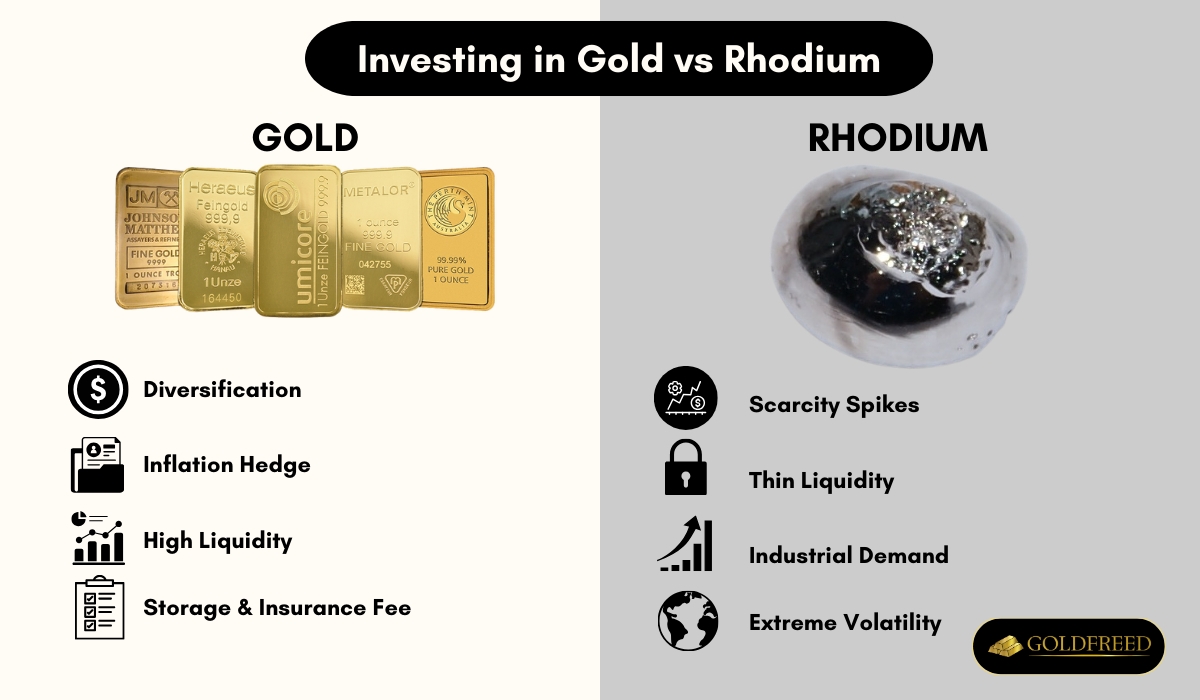
Investing in gold brings portfolio diversification, a hedge against inflation, and high liquidity, yet it also brings storage and insurance fees, capital gains tax, and no passive income. Gold typically performs well during economic downturns and geopolitical unrest, adding balance and security through hedging and liquidity, but it is expensive to keep in a secure repository and carries a theft risk.
Rhodium, another gold, is used mainly for jewelry plating and industrial catalysts, so its price is driven by manufacturing demand rather than by inflation or unrest. It offers no yield, lacks a deep resale market, and is rarely stored by retail investors, so its pros are limited to potential scarcity spikes, while its cons include extreme volatility, thin liquidity, and no safe-haven status.
Gold's main benefit is its function as an established shop of worth that gave a feel of peace for a part of my portfolio during times of economic uncertainty, I could well trade gold ETFs through my secure account, yet the cost of gold can stay static for given durations and yields no return like profits, a substantial restriction for long-term goals. Rhodium, by contrast, rose because of its industrial uses, especially in the automotive field, and provided a possibility for considerable profits that gold couldn't offer. However, the industry for rhodium is illiquid, the spreads between purchasing and reselling prices were wide, and I found it hard to locate a trustworthy system for buying physical rhodium.
Thomas GoldfreburgInvestor at Goldfreed
What are some tips for investing in gold and rhodium?
Some tips for investing in gold and rhodium are provided below.
- Buying gold bars or ingots is a direct way to invest in gold, offering a straightforward tip for investors
- Gold can be bought through gold or commodity focused mutual funds, providing an easy tip for diversified gold investment
- Futures allow you to directly invest in gold, serving as a tip for those interested in advanced trading strategies
- Experts recommend exposure to gold through exchange traded fund as a reliable tip for modern investors
- Larger investors seeking direct exposure to the price of gold can buy gold directly through bullion, a tip for high-net-worth individuals
- Gold ETFs are low cost way to invest in gold, giving a cost-effective tip for gold investment
- Financial advisors generally recommend limiting gold exposure to less than 3% of one's overall portfolio as a tip for balancing investments
- Rhodium has 95% industrial use rate, an important tip for assessing its investment potential
Physical bars and coins from reputable mints like Maple Leaf or Australian Nugget give direct ownership, while platforms like BullionVault let private buyers trade small gram amounts at competitive prices and store the metal in secure vaults around the world. Larger investors seeking full allocation buy bullion directly, but owning physical gold is less efficient than holding an exchange-traded fund whose price is linked to the price of gold. SPDR Gold Shares (GLD) and iShares Gold Trust (IAU) are the two largest gold ETFs and can be bought and sold like a stock inside an ordinary brokerage account. Rhodium has no recognized ETF and 95% of supply is industrial, so coins are not principal players in the market. Most production comes from South Africa, and exposure is obtained through specialty dealers or futures with position sizes kept small because the metal is thinly traded. Investors tend to focus on platinum and silver instead, since both are easier to buy and sell, but anyone willing to accept higher volatility can add a tactical slice of rhodium for diversification. Choose gold if you want the most liquid precious-metal market with multiple low-cost vehicles, choose rhodium only if you can tolerate concentration and geopolitical risk and are prepared to monitor refinery output from South Africa closely.
I contributed to my stance bit by bit over time. I opted for stability and worldwide acknowledgement, so I decided to buy into a respected exchange-traded fund (ETF). This approach offered exposure without the complexities of immediate physical possession, because the ETF holds the physical metal. I bought a couple of one-ounce coins from a respected seller, then I allocated a part of my fund for a secure storage container, because I found that tangible gold needs safe keeping. I devoted substantial duration to study the specific supply and consumption mechanism of the metal industry and I probed validation operations. I regarded the venture as a long-term shop of worth and I did not respond to short-term cost fluctuations. And, finally, I monitored all charges.
Thomas GoldfreburgInvestor at Goldfreed
Expert behind this article

Thomas Goldfreburg
Thomas Goldfreburg is a gold investment advisor, author and founder of Goldfreed. Thomas's expertise is built on an academic foundation of a Bachelor of Science in Economics from Stanford University and complemented by market experience. Thomas specializes in gold IRA, ETF, 401k, and physical gold investments.