Gold investment strategy focuses on low risk and targets long-term growth, includes physical bullion, and offers more stable long-term returns than silver with lower volatility. Silver investment strategy includes physical bullion, ETFs, and mining funds, targets short-term growth and high risk, and delivers higher potential returns than gold, yet it demands tactical timing guided by the gold-to-silver ratio.
Expert behind this article

Thomas Goldfreburg
Thomas Goldfreburg is a gold investment advisor, author and founder of Goldfreed. Thomas's expertise is built on an academic foundation of a Bachelor of Science in Economics from Stanford University and complemented by market experience. Thomas specializes in gold IRA, ETF, 401k, and physical gold investments.
What is a better investment, gold or silver?
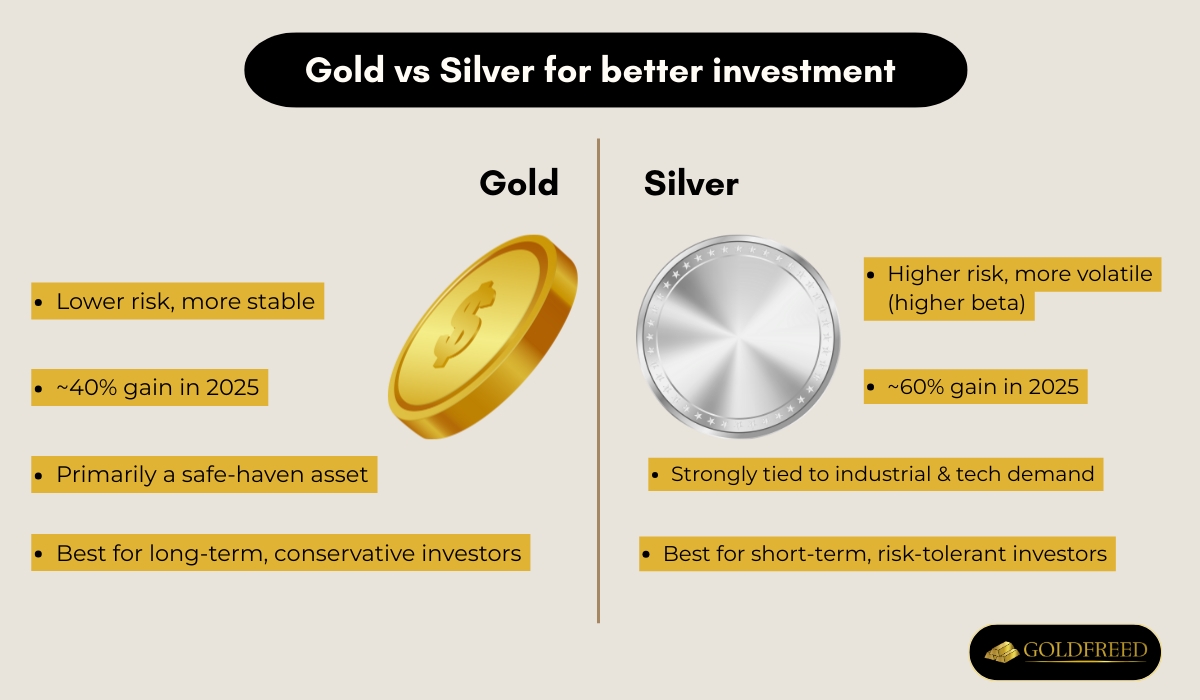
Silver is a higher-beta, higher-risk, higher-reward investment than gold, and in 2025 silver outshone gold, jumping nearly 60% while gold rose 40%. Because more than half of all silver demand comes from heavy industry and high technology, silver is more tightly linked with the global economy and offers higher annual returns historically when industrial demand is high. Gold is more stable, less volatile, and posts steadier long-term returns that average about 2.6 % above inflation, but it posts negative returns in roughly one-third of years. Over the complete 65-year timeframe gold outperformed silver, yet silver has had higher cumulative growth since 1960. Gold is the better choice for long-term investors who prioritize security, while silver suits short-term speculators who accept volatility.
The gold-to-silver ratio, calculated by dividing the current price of a gram of 24K gold by a gram of 999 silver, helps determine which metal is undervalued at a given time. A lower ratio implies silver is relatively undervalued, while a falling ratio makes gold appear more promising. Gold is about 82 times more expensive per ounce than silver, making silver a cheaper alternative with many of the same benefits. Gold's higher price tag reflects its rarity and status as a safe-haven asset that provides a hedge in market downturns. Investors who prefer exposure without physical ownership use Exchanged- Traded Funds (ETFs). Silver ETFs track silver prices and offer better short-term returns if volatility is tolerated, whereas gold ETFs follow gold prices and are a stronger portfolio diversifier.
Gold possesses less unpredictability than silver and has served as a dependable mainstay in the financial ocean. Gold’s past fame as a safe-haven asset makes it the foundation of a long-term wealth conservation scheme. Silver exhibited varied fluctuations, and its larger cost unpredictability is seen as a chance for growth rather than mere conserve, yet the same feature introduces higher risk. I researched both assets and found that gold systematically kept its amount, providing useful protection against monetary reduction and reflation, while silver's dual characteristic argent providing as a monetary element and AG providing as a developed good adds industrial demand that can amplify price swings. Material possessions like tangible precious metal ingot could not duplicate the palpable feel of safety that gold delivers, whereas silver's larger cost unpredictability may reward investors who tolerate its wider price swings.
Thomas GoldfreburgInvestor at Goldfreed
When choosing between gold and silver, gold remains the superior long-term inflation hedge and portfolio diversifier, while silver offers a cheaper, more volatile growth play tied to industrial megatrends, and ETFs provide convenient, liquid access to either metal without storage concerns.
What is a gold IRA investment?
A gold Individual Retirement Account (IRA) is a type of self-directed individual retirement account that allows investors to hold physical gold, silver, platinum, and palladium as investments within the account. It functions the same as a regular IRA, only instead of holding paper assets it holds physical bullion coins or bars. Gold IRA, alternatively called precious metals IRA, is a traditional IRA, Roth IRA, or other retirement account that invests in physical gold. Gold IRA requires gold to be at least 99.5% pure and to be in the form of IRS-approved coin or bar products.
Gold IRA assets are stored in an IRS-approved storage facility and are not taken home by the account holder. Gold IRA requires a specialized custodian to administer the account and typically incurs an annual fee of approximately $250, which includes a yearly administration fee of about $100 and a storage fee of about $150. Gold IRA is opened with companies like Goldco, Augusta Precious Metals, Noble Gold, Birch Gold Group, and Preserve Gold, with minimum investments ranging from $5,000 to $50,000 depending on the provider. Gold IRA is funded by a rollover from a 401(k), a transfer from another IRA, or a direct contribution, and it maintains similar tax advantages to traditional IRAs, including tax-deferred growth for traditional accounts and tax-free withdrawals for qualified Roth IRA distributions.
A gold IRA investment is a strategic assignment of a part of my retirement funds into tangible physical assets. It drifts off from a full dependence on the performance of conventional paper securities like shares and obligations. I recognize that having precious metal within an IRA allows me to experience the tax benefits of a retirement account while profiting from its past function as a safe-haven advantage. Physical precious metal has retained its purchasing ability for decades, offering protection against the underlying unpredictability and possible reduction of fiat money. This is a long-term conservation plan of action, not a theoretical bet for fast growth.
Thomas GoldfreburgInvestor at Goldfreed
What is the best gold and silver investment strategy?
The most recommended investment strategy by most financial advisors is a balanced approach allocating 10-15% of your portfolio to precious metals with 60-70% in gold and 30-40% in silver. This balanced allocation captures the unique benefits offered by each metal because gold provides a hedge during sustained periods of rising inflation and silver is partially uncorrelated to traditional assets. Exposure to both metals is vital since gold excels as a stable store of value and crisis protection while silver posted a 25.66% year-over-year gain and benefits from industrial demand where more than half of all silver's demand comes from heavy industry and high technology. Investors can implement this allocation through ETFs, mining stocks, streaming/royalty companies, and physical bullion. ETFs have become a popular way to gain exposure while physical gold and silver have no counterparty risk. It is critical to own enough physical metal to make a material difference to the portfolio and store it securely in options like InstaVault, private vaults, or third-party depositories.
Future outlook reinforces the 60-70% gold and 30-40% silver split because central banks' steady buying has created a lasting price floor and both metals remain worth more than ever. Growth-oriented investors will increase silver exposure to capture upside from expanding technology and green-energy demand. Gold is expected to keep acting as portfolio insurance against systemic risk and economic downturns. Advice for the next decade is to have exposure to both metals in your investment portfolio and not just one or the other, maintaining the balanced 10-15% precious-metals sleeve within a broadly diversified portfolio.
I allotted a small, specified proportion of my portfolio to tangible precious metals like gold and silver, working a plan of action of orderly, progressive accumulation instead of trying to time the market. I decided to buy a set monetary quantity of metal each period, a dollar-cost averaging pattern that constructed a considerable stance over various decades and smoothed away unpredictability. Realizing that precious metal's industrial uses provided a varied evolutionary drive as opposed to the pecuniary part, I modified my belongings to involve a larger percentage of precious metal, concentrating on the long-term conserve of principal instead of high-risk profits. Seeing it as a dual-purpose resource for both security and industrial consumption growth, this plan of action offered a foundational level of protection that I keep.
Thomas GoldfreburgInvestor at Goldfreed