Uranium is a high-growth opportunity linked closely to energy transition trends; it is a cornerstone resource for long-term energy solutions and faces short-term volatility but strong long-term fundamentals. Gold, by contrast, is a safe-haven asset when traditional investments like stocks, bonds, and currencies face volatility. Investors seeking exposure to uranium can turn to uranium ETFs, like the Sprott Uranium Miners ETF (URNM), which tracks an index of uranium shares, while those favoring stability may prefer gold's defensive characteristics.
Expert behind this article

Thomas Goldfreburg
Thomas Goldfreburg is a gold investment advisor, author and founder of Goldfreed. Thomas's expertise is built on an academic foundation of a Bachelor of Science in Economics from Stanford University and complemented by market experience. Thomas specializes in gold IRA, ETF, 401k, and physical gold investments.
Which is a better investment: uranium vs gold?
Investors choosing between uranium and gold confront two markets moving on different clocks. Gold enjoys a timeless bid from institutions seeking disaster insurance, John Ciampaglia notes that institutional investors are coming back to gold as macro uncertainty resurfaces. Uranium, in contrast, derives its value from a technological shift: more acceptance of nuclear power gives uranium additional upside that gold cannot replicate with certainty. While gold balances portfolios, uranium is a transformative fuel capable of rewiring global electricity supply.
The scarcity argument tips further toward uranium. Uranium short supply today implies future undersupply when new reactors come online, whereas above-ground gold stocks grow every year through recycling and modest mine output. Stockpiles tell the starker story: uranium stockpiles are at lowest levels in nearly 20 years, leaving the market with little buffer once contracts roll forward. Rozencwajg remains constructive on uranium precisely because this combination of rising structural demand and falling inventories outpace any acceleration in mine supply. Gold's scarcity is fixed and well understood, uranium's scarcity is emergent and compounding.
I viewed uranium as a compelling option because its basic function in the shift to low-carbon caseload capacity is expanding. This trend occurred in considerable asset appreciation, while gold demonstrated steady but stagnant. Precious metal provided limited returns that hardly outmatched rising prices, so I allocated a part of my portfolio to tangible gold bullion only as a timeless shop of worth. I funded an active metal focused on uranium, and increasing demand and limited supply occurred. Gold failed to give active growth, while uranium outperformed my gold investments.
Thomas GoldfreburgInvestor at Goldfreed
Which is safer as a long-term investment: uranium vs gold?
Gold is the safer long-term store of value acting as a safe-haven and a risk diversifier. In contrast, gold stocks are higher risk, but the metal itself is a safe asset that institutional investors are coming back to, according to John Ciampaglia.
Uranium, on the other hand, offers a different risk profile. While uranium has strong long-term fundamentals and demand is growing due to nuclear power, its price is more sensitive to regulatory shifts, mine restarts, and geopolitical sentiment. Thus, for investors whose first priority is capital preservation across decades, gold bullion remains the lower-volatility choice, whereas uranium suits those willing to accept greater turbulence in exchange for potential outperformance tied to the energy transition.
Gold is safer. Its value exhibited steady during times of economic uncertainty, and its price is not linked to financial stock exchange. The cost of gold moved inversely to the strength of the U.S. dollar and to interest rates, so it maintains wealth. I monitored its operation over various decades and, although I observed periods of stagnation, yet this solidified my view of gold as a trustworthy shop of worth. Uranium carries greater risk. My experience with uranium revealed a very different pattern: I saw significant unpredictability. Its cost sharply reacted to geopolitical events, regulatory changes, and to utility contracting phases, so prices moved with sudden swings. Therefore, for a long-term holder seeking calm preservation, gold surpasses uranium.
Thomas GoldfreburgInvestor at Goldfreed
Which price is more volatile: for uranium or gold?
Uranium has been volatile, spot price is volatile because the sector is both small and opaque, so the spot market is certain to experience sharp, headline-grabbing moves. NYMEX uranium 1st futures contract price hit a new high of US$106.40 a pound on 01 February, yet the price dropped sharply to around $63.50/lb by mid-March, before reaching as high as US$82.30 per pound. Russia has been a key factor in recent uranium price volatility, since uranium prices jumped after Russia restricted uranium exports to the US.
Gold has much lower volatility than a lot of the other asset classes, while gold mining equities are more volatile than the physical commodity. Gold basically moved from $1,800 to $2,500 an ounce, and gold price recovered most of a -4.5% plunge by rebounding 5.9% to US$2,718/oz. The result is that uranium equities are more volatile, and uranium's trajectory towards a potential $100/lb makes the metal the wilder ride when compared with gold's steadier climb.
Gold's cost fluctuates in modest proportion changes over weeks or longer time, so I determine the cost of metal to be unstable. I see that precious metal's value is affected by worldwide economic uncertainty, monetary variations, and macroeconomic factors, and is influenced by reflation prospects, its shifts remain within recognizable range. The Uranium industry is contrasting: its cost is sensitive to reactor authorization announcements, and its valuation shifts in response to geopolitical events involving changes in official policy. Sharp movements occur within a less range. Therefore, uranium price is more volatile than gold.
Thomas GoldfreburgInvestor at Goldfreed
Which is more liquid: uranium vs gold investment
Gold is one of the most liquid assets in the world, trading with tight spreads around the clock, while uranium changes hands through short-term contracts for delivery in 30 days that few counterparties quote. Gold ETFs known for high liquidity and tight spreads let investors enter or exit million-dollar positions within seconds, whereas direct uranium exposure means negotiating private offtake agreements that take weeks to clear. ETF structures offer liquidity advantages over direct uranium investment: shares of GDX, a highly liquid ETF, trade every second on public exchanges, but uranium stockpiles are at their lowest levels in nearly 20 years, so sellers with physical material rarely post firm bids. In size, depth, and speed of transaction, gold therefore remains the more liquid choice.
The international gold market works endlessly, offering transparent pricing and the ability to exchange my asset into cash nearly immediately. I have been able to purchase gold ingot and trade bullion easily through many vendors and online platforms, completing transactions within an hour. My experience with gold has featured its fungibility, allowing me to take cash in a part of my gold investment to raise money. Uranium, by contrast, is not for an investor wanting immediate access to an asset. My first endeavor into uranium venture revealed an industry defined by substantial illiquidity, where deals needed a long duration of negotiating, and the whole process was slow. I found that exchanging my uranium holdings into cash was not a direct procedure, the main technique referred through written agreement with service organizations, and I encountered an absence of a common, available marketplace.
Thomas GoldfreburgInvestor at Goldfreed
Does gold offer better returns than uranium?
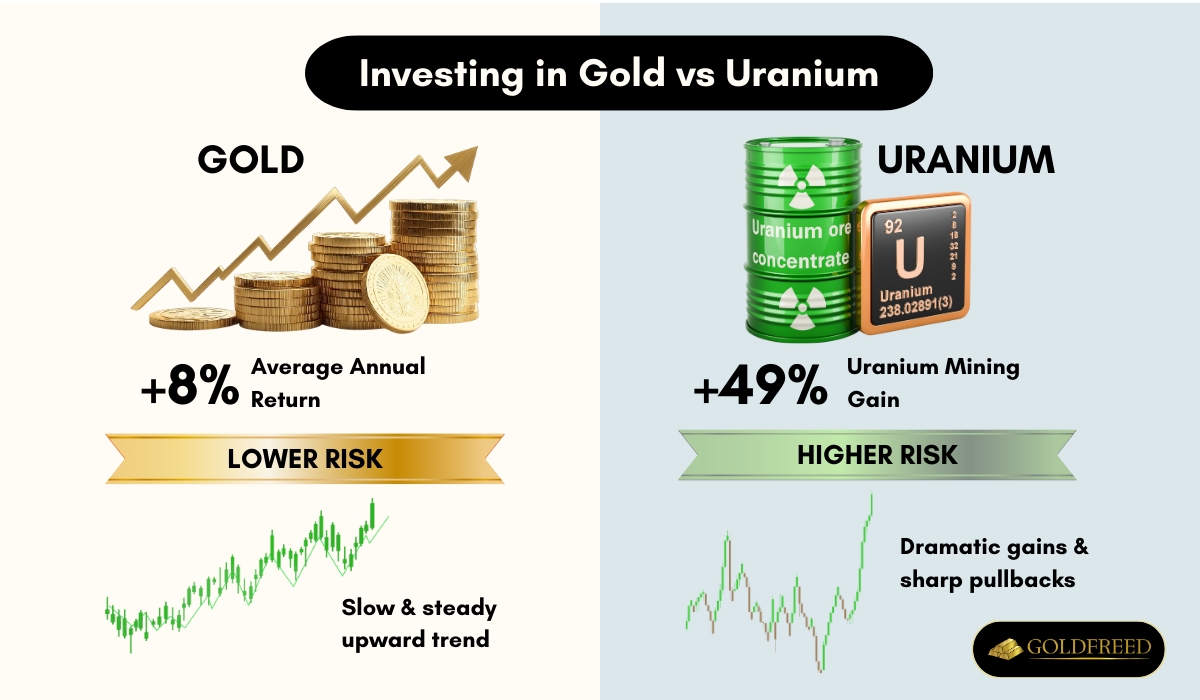
Gold averaged 8% annual returns over decades, a figure that reflects steady compounding through multiple cycles. Yet uranium miners delivered equally impressive returns during demand spikes: when uranium price doubled, and one benchmark miner posted a 49% gain. Those bursts occur because nuclear utilities must purchase uranium regardless of price, concentrating upside into short windows.
Gold historically outperformed during stagflationary periods, preserving capital when traditional assets struggle, but no asset class delivers superior returns indefinitely. Metal mining ETFs offer potentially higher returns during commodity bull markets, yet they also magnify downside once the cycle turns. Consequently, gold provides lower-volatility, lower-reward exposure, while uranium offers episodic surges that eclipse gold for brief intervals with certainty.
Gold's income has been reliable, though not been impressive, its price has steadily appreciated, but it does not experience dramatic rises viewed in other commodities. My uranium venture revealed a risk-reward profile: during revived interest in atomic power, the value of my uranium holdings increased, and the revenues exceeded those of precious metal. However, the value of my uranium ownership reversed sharply when geopolitical conflict eased, so the returns are accompanied by intense unpredictability. Gold serves as a dependable store of value during times of economic uncertainty, and its upward trend has added a reassuring feel of stability to my portfolio.
Thomas GoldfreburgInvestor at Goldfreed
Which is taxed more: gold or uranium investments?
The IRS deems gold a collectible, so long-term capital gains are subject to a special 28% maximum federal income tax rate. While two-to-eight points above the 20% top rate that applies to uranium shares in mining companies held for more than one year. Short-term gains on gold are treated as ordinary income and reach 37%, the same ceiling that hits short-term profits on uranium mining stocks. Funds that hold gold futures contracts have a top federal tax rate of 26.8%, while physical uranium itself is taxed only when the metal is sold, at the same capital-gains schedule that governs other raw materials, so the effective rate never exceeds 20% unless the three-year-old 3.8% net investment income tax also applies. Bottom line: every common gold structure: bullion, ETF, or futures-faces either 28% or 26.8% on long-term gains, whereas uranium exposures, whether through mining shares or direct ownership, top out at 20% (plus the possible 3.8% surtax), making gold the more heavily taxed of the two assets.
What are the pros and cons of investing in gold or uranium?
Gold adds diversification to a portfolio and remains a time-tested hedge against economic uncertainty, appealing when inflation runs high or recessions loom, its price is less tied to industrial cycles, so it adds balance and security when equities wobble.
Yet precious metals and natural resources investments carry higher headline risk: mines are nationalized, royalties are tweaked, or new taxes are suddenly imposed, and bullion itself yields no income while storage and insurance nibble at returns.
Uranium, by contrast, is driven by a hard floor under supply and by environmental policy that favors the energy transition; the radioactive mineral is also used for producing medical isotopes, giving it a second demand column.
Still, there is no open commodities market for the radioactive mineral, so price discovery is thin and sentiment swings violently, the economics of mining uranium involves country risk, ore grade, depth and infrastructure, and we are in a uranium cycle where permit delays or reactor shutdowns erase paper gains.
Gold conserves money and gives a psychological backbone that material possessions could not, so I believe it is an important part for portfolio stability. Gold does not develop yield like profits or interest, and I found its main drawback to be a lack of substantial growth, therefore I do not consider gold as a principal income generator. Uranium investment is defined by broader risks and possible advantages: the prospect for considerable yields during a uranium bull market is undeniable, yet this possibility comes with intense volatility and complication. The sector is influenced by geopolitical factors, regulatory shifts, and the operational risks of production companies, making it riskier than gold.
Thomas GoldfreburgInvestor at Goldfreed
What are some tips for investing in gold and uranium?
Investors viewing gold stocks to buy now should prioritize major producers and mid-tier companies, particularly miners with strategic diversification across essential minerals.
Some tips for investing in gold and uranium are provided below.
- Look at the Sprott Physical Uranium Trust for exposure to physical uranium and gold;
- Stabilize your portfolio by diversifying the resources segment with other energy stocks alongside uranium and gold;
- Allocate in the 5-10 % portion to gold for diversification;
- Use the Global X Uranium ETF (URA) for tracking a basket of mining firms as part of uranium investing;
- Consider well financed junior uranium mines with no immediate need to sell shares at low prices;
- Gold equities must demonstrate fundamental positioning and sound strategy for successful investing;
- Remember that physical gold is steadier for pure inflation hedging, recommending the Sprott Physical Gold Trust which holds 100% allocated physical gold;
- Uranium offers ample opportunities for miners, pointing to potential long-term growth.
Which option is better for you: investing in gold or uranium? Gold remains a time-tested hedge against rising inflation. Uranium, in contrast, is a cyclical, supply-sensitive play: prices are driven by utility contracting cycles and supply chain concerns, as seen when uranium stocks were boosted in June.
What are some tips for investing in gold and uranium? For gold, limit the position to a modest 5-10 % of total assets, favour physical gold or the Sprott Physical Gold Trust, and assure any gold equities demonstrate fundamental positioning and sound strategy. Investors seeking Canadian-listed exposure can use the Global X Uranium Index ETF (TSX: HURA), and those wanting nuclear utility exposure can access Constellation Energy Corporation (CEG).
I assigned a set proportion of my financial assets to gold and began with small gradual purchases of ingots from respected traders, keeping a controlled approach regardless of short-term cost variations. I know that gold is a foundational portion of my portfolio: a physical resource I could hold directly and a dependable shop of worth during times of economic uncertainty, giving it steady value over the decades rather than a vehicle for fast growth. For uranium finance, I devoted substantial time to understanding the nuclear fuel phase, the particular situations challenging mining companies, and the intricate components that drive this industry: geopolitical energy policy and contracting cycles. My investment is focused on a couple of chosen equities of manufacturers with solid finances, admitting the intrinsic volatility and long-term perspective needed for this field.
Thomas GoldfreburgInvestor at Goldfreed